
The effectiveness of generative AI hinges on a critical, yet often overlooked, element: prompt adherence. This refers to how well an AI model can accurately interpret and execute the instructions given in a text prompt. While modern AI can produce stunningly complex visuals and nuanced text, the quality of the output is directly tied to the quality of the input. Learning how to write effective AI prompts is quickly becoming a valuable skill for professionals in any industry. When an AI fails to adhere to a prompt, the result can range from a minor inaccuracy to a completely irrelevant output, a phenomenon often described as garbage in, garbage out.
Why AI Struggles with Following Instructions
The challenge of prompt adherence stems from the fundamental way AI models work. They don't "understand" language in the human sense. Instead, they are trained on vast datasets to recognize statistical patterns between words and images. This process can lead to several common failures:
- Misinterpreting Relationships: An AI might understand the individual concepts in a prompt but fail to grasp their relationships. For instance, a prompt for "a red cube on top of a blue sphere" might result in a blue cube next to a red sphere. This happens because the model prioritizes the concepts of "red," "blue," "cube," and "sphere" over the spatial instruction "on top of."
- Instruction Overload: Overly complex prompts with too many instructions can confuse the model, leading to an incoherent or incomplete response. It's often more effective to break down complex requests into a series of smaller, more focused prompts.
- Ignoring Negations: Models often struggle with negative prompting. An instruction like "a landscape with no trees" might still produce an image with trees because the model's training data strongly associates "landscape" with "trees."
- Hallucinations: AI models sometimes invent facts, details, or sources that were not in the prompt or training data. This is because they are designed to predict the next most likely word or pixel, not to verify factual accuracy.
Techniques for Improving Prompt Adherence
The good news is that prompt adherence is a skill that can be improved through strategic prompt engineering. By crafting clearer and more structured instructions, you can significantly increase the chances of getting the desired output. This is an iterative process that requires experimentation and refinement. Here are some proven techniques:
- Be Specific and Clear: Vague prompts lead to vague results. Instead of "a dog," a more effective prompt would be "a photorealistic portrait of a golden retriever puppy, sitting on a sunlit grassy field, happy expression, shallow depth of field." Providing context is king and helps the AI tailor its response.
- Use a Structured Format: Breaking down your prompt into clear sections for role, task, context, and expected outcome can dramatically improve results. For image generation, specifying the subject, setting, lighting, camera angle, and style provides clear guidance.
- Employ Few-Shot Prompting: Provide the AI with one or more examples of the desired input-output pair. This technique, known as few-shot or one-shot prompting, helps the model understand the desired format and style.
- Refine and Iterate: Think of the AI as a collaborative partner. If the first result isn't perfect, use follow-up questions and provide feedback to refine the output. Sometimes, asking the AI to critique its own response can help identify weaknesses.
| Challenge | Example Failure | Solution |
|---|---|---|
| Attribute Bleed | "A red car and a blue boat" results in a purple car and a purple boat. | Use more structured language or generate elements separately. For example, use multimodal prompts or break it down: "A red car parked on a street. Next to it, a blue boat on a trailer." |
| Positional/Spatial Errors | "A cat sitting on a bookshelf" produces a cat floating next to the shelf. | Emphasize prepositions with weighting or use models known for better spatial understanding. Simplify the scene to focus on the core relationship. |
| Ignoring Negative Prompts | "A portrait of a man, no beard" results in a man with a beard. | Use the dedicated negative prompting feature if available. Phrase the prompt positively: "A portrait of a clean-shaven man." |
| Instruction Overload | A long, complex prompt with multiple subjects and actions results in a chaotic image missing key elements. | Break the request into smaller, sequential prompts. Focus on one primary subject and action per prompt, using iterative refinement to build the scene. |
Applications in Art and Education
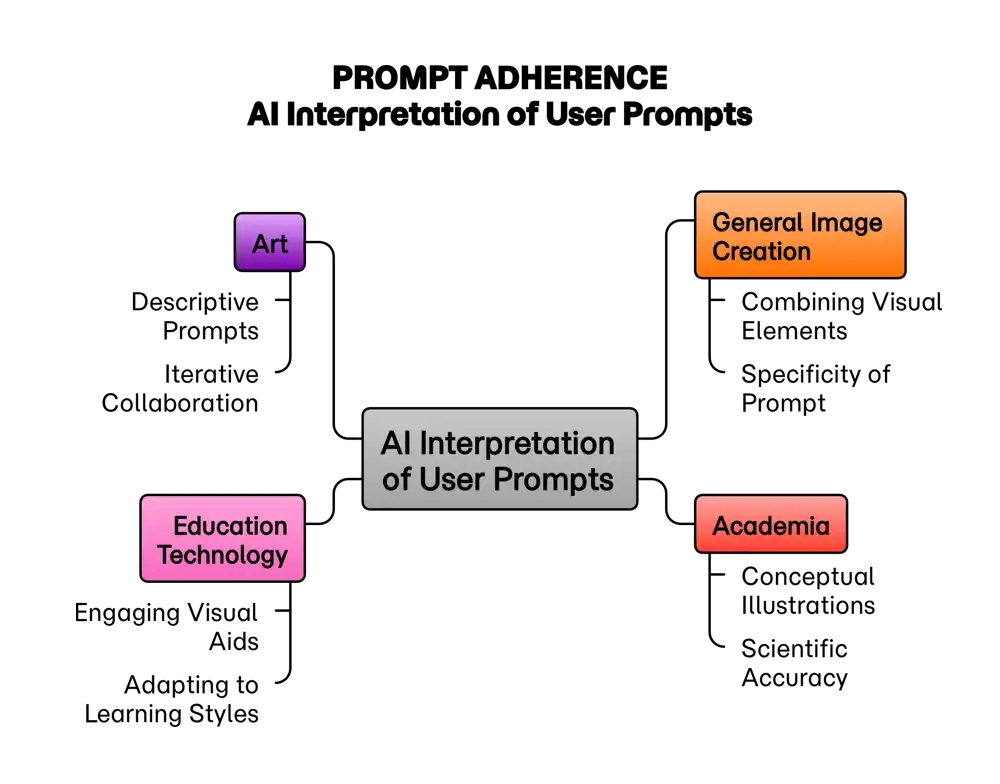
In the realm of art, prompt adherence is crucial for artists using AI as a creative partner. By mastering creative prompting, artists can guide diffusion models to generate base images that they can then refine, or experiment with styles and compositions with greater control. The process becomes an iterative dialogue between the artist and the AI.
In education, clear prompting enables teachers to create accurate visual aids and personalized learning materials. For students, learning to structure a prompt task helps them visualize complex concepts and articulate their ideas with precision, fostering critical thinking about how we communicate with automated systems.
| Technique | Description | Example |
|---|---|---|
| Role-Playing Persona | Assigning a role to the AI to frame its response. | "Act as a professional photographer. Generate an image of..." |
| Chain-of-Thought (CoT) | Asking the AI to "think step-by-step" to break down complex problems. | "First, describe the main subject. Second, describe the background. Third, combine them into a photorealistic image..." See the chain of thought framework. |
| Provide Examples | Giving one or more examples of the desired output (few-shot prompting). | "Here is an example of the style I want: [image or description]. Now, create a new image of a tiger in that style." |
| Specify Format | Clearly defining the structure of the desired output. | "Provide the answer as a bulleted list." or "Generate a wide-shot, cinematic-style image." |
Ready to transform your AI into a genius, all for Free?
Create your prompt. Writing it in your voice and style.
Click the Prompt Rocket button.
Receive your Better Prompt in seconds.
Choose your favorite AI model and click to share.
Summary of AI Prompt Adherence
AI prompt adherence is the measure of how well a model follows a user's textual instructions. The quality of AI-generated content is highly dependent on the prompt clarity and specificity provided by the user. Common challenges include misinterpreting relationships between objects, handling complex or negative instructions, and generating factually incorrect information, or hallucinations. To improve adherence, users should employ detailed, structured prompts, provide examples, and engage in an iterative process of refinement. Techniques like assigning a persona, using chain-of-thought reasoning, and breaking down complex tasks can significantly enhance the accuracy and relevance of the output. Mastering these prompt engineering skills allows users to move from being passive questioners to active collaborators with AI, unlocking its true potential across diverse applications like art, education, and business.