
In an age of high-definition clarity and slick digital precision, a powerful counter-trend has emerged, fueled by artificial intelligence: the revival of vintage aesthetics. From the warm, grainy texture of old film to the distinct fade of a VHS tape and the bold lines of classic comic books, generative AI is making it easier than ever to evoke the visual qualities of bygone eras. This technology is not merely a nostalgic indulgence; it is being strategically applied across diverse fields like marketing, academia, and education to create compelling and emotionally resonant content.
What are AI Vintage Aesthetics?
AI vintage aesthetics refers to the use of artificial intelligence to create new images that mimic the look and feel of older media formats. By training on vast datasets of historical photographs, films, and illustrations, AI diffusion models can learn to replicate the specific characteristics that define a particular era's visual style. This includes a range of effects such as:
- Film Grain and Noise: The slightly blurry and textured quality of photographs shot on film, which AI can now add to digital photos to give them a timeless, cinematic feel.
- Sepia Tones and Faded Colors: The warm, brownish tint of early photographs or the washed-out look of aged color prints, easily replicated through AI filters.
- Light Leaks and Vignetting: The accidental and often charming imperfections of older cameras, where light bleeds into the frame or the edges of the photo are darkened.
- VHS Fade: The soft, slightly distorted, and color-bled appearance of video footage from the 1980s and 90s, complete with scan lines and tracking errors.
- Vintage Comic Styles: The bold outlines, halftone dot patterns (Ben-Day dots), and limited color palettes reminiscent of mid-20th-century comic books.
AI tools can apply these effects to existing images or generate entirely new visuals from a text-to-image prompt. Users can now craft a detailed nostalgic scenarios prompt to conjure images in the style of a 1920s sepia-toned portrait or a 1960s Polaroid, complete with characteristic imperfections.
Marketing: Weaving Narratives of Authenticity and Nostalgia
In the crowded digital marketplace, brands are constantly seeking ways to forge a deeper connection with consumers. The vintage aesthetic, powered by AI, has become a potent tool in their arsenal. By tapping into a nostalgia prompt, marketers can evoke feelings of comfort, trust, and authenticity. This strategy is effective because it uses the emotional resonance of retro styles to make modern brands feel more established and memorable. For example, Burger King used AI to reinterpret its 1970s advertising, creating a campaign that felt both nostalgic and new.
Incorporating vintage styles into a prompt for marketing can signal to consumers that a brand values quality and longevity over fleeting trends. This is particularly effective for brands looking to build a loyal community. AI allows for the rapid generation of different vintage aesthetics, enabling dynamic and extensive campaigns that can be tailored to specific demographics. Brands like Coca-Cola have successfully used AI to reimagine classic ads, blending the old with the new to create fresh and engaging content.
| Application | AI Techniques to Evoke Distinct Visual Qualities |
|---|---|
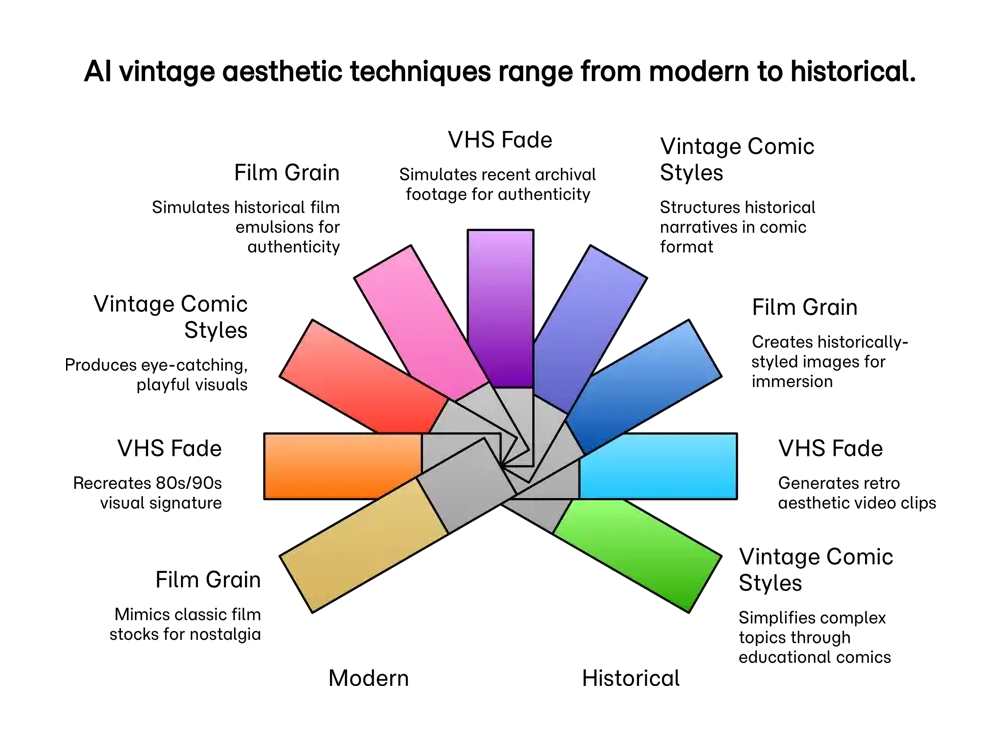
| Developing brand narratives that suggest authenticity and timelessness, creating standout social media campaigns, and offering personalized retro-themed customer experiences. | Film Grain: AI applies grainy textures that mimic classic film stocks to give a cinematic and nostalgic feel to advertisements. VHS Fade: This technique recreates the visual signature of the 1980s and '90s, including color bleeding and scan lines, to connect with consumers through shared cultural memories. Vintage Comic Styles: Utilizes bold outlines and halftone patterns to produce eye-catching visuals. |
Academia: Reconstructing and Visualizing the Past
For historians, archaeologists, and digital humanists, AI-generated vintage imagery offers groundbreaking possibilities for research and public engagement. This technology can be used to reconstruct historical figures, artifacts, and environments with a level of detail that was previously unimaginable. By analyzing portraits, sculptures, and written descriptions, AI can generate photorealistic "portraits" of people from the past, making history feel more immediate and relatable. This allows for a more personal connection to historical narratives.
Beyond individual portraits, AI is being used to restore and complete damaged artworks and interpret complex historical materials. A project at Stanford University, for instance, is developing an AI framework to help interpret historical documents by analyzing text, handwritten notes, and drawings. This approach treats archival documents as "deep sources," attending to the many layers of meaning they carry. This not only aids in art historical analysis but also allows the public and researchers to experience history in a more profound way.
| Application | AI Techniques to Evoke Distinct Visual Qualities |
|---|---|
| Visualizing historical scenes, figures, and environments for which limited or no visual records exist, thereby aiding research and interpretation. It allows historians to create "photorealistic" depictions and explore different visual representations of the past. | Film Grain: AI simulates the physical properties of historical film to create images that appear as if they were photographed in a specific time period. VHS Fade: This is used to simulate the look of more recent archival footage, providing a sense of authenticity for events from the late 20th century. Vintage Comic Styles: Helps in structuring and visualizing historical narratives in an accessible format for publications or presentations. |
Education: Engaging Students with the Visual Past
In the classroom, AI-generated vintage images are proving to be a valuable tool for engaging students and fostering critical thinking. By bringing historical events and concepts to life visually, educators can make learning more dynamic and memorable. Teachers can use AI to create custom visual aids for their lessons, such as "photographs" of events that occurred before the invention of photography. For instance, a history teacher could generate an image of the signing of the Constitution in the style of a 19th-century photograph to spark classroom discussion.
Moreover, these tools facilitate creative explorations of history and can be used to teach media literacy. Educators can present students with both real and AI-generated historical images and challenge them to identify inconsistencies. Lesson plans are now being developed that guide students in using AI image generators to explore historical subjects, analyze the results for accuracy, and understand the ethical considerations of this powerful technology. This teaches students to critically evaluate the visual information they encounter daily, a crucial skill in the digital age.
| Application | AI Techniques to Evoke Distinct Visual Qualities |
|---|---|
| Enhancing learning materials to make history more engaging and to spark students' imaginations. AI allows educators to generate custom visuals for lessons and facilitate a deeper understanding of past eras. | Film Grain: Creates historically-styled images for presentations, immersing students in a particular time period. VHS Fade: Generates video clips with a retro aesthetic for lessons on late 20th-century history and media studies. Vintage Comic Styles: Simplifies complex topics through the creation of educational comics and engaging visual aids that are appealing to students. |
A Window to the Past, Powered by the Future
The rise of the AI image vintage aesthetic is more than just a fleeting trend. It represents a fundamental shift in how we create, interact with, and understand visual content. By allowing us to seamlessly blend the aesthetics of the past with the technology of the future, AI is opening up new avenues for storytelling, research, and education. Whether it's a marketer crafting a nostalgic decades prompt, a historian reconstructing a lost masterpiece, or a teacher engaging a new generation of students, the ability to evoke the distinct visual qualities of older media formats is proving to be an invaluable asset in a visually-driven world.
Ready to transform your AI into a genius, all for Free?
Create your prompt. Writing it in your voice and style.
Click the Prompt Rocket button.
Receive your Better Prompt in seconds.
Choose your favorite AI model and click to share.
Summary of Allure of the Past; Vintage Aesthetics
The application of AI-powered vintage aesthetics is making a significant impact across diverse fields by artfully recreating the distinct visual qualities of older media. In marketing, these aesthetics help brands forge an emotional connection with consumers by evoking feelings of nostalgia and authenticity. In academia, researchers and historians can now visualize historical events or figures for which no photographic evidence exists, offering new perspectives for study and interpretation. AI tools allow for the creation of images that simulate the appearance of photographs from a specific era, complete with authentic-looking flaws and textures. Education is also being transformed as these tools enable the creation of more engaging and immersive learning materials. By generating images with intentional imperfections like film grain, the color degradation of VHS tapes, or the bold lines of retro comics, AI offers a versatile and powerful way to communicate, whether the goal is to sell a product, teach a historical lesson, or explore the past in new ways.