
The relentless advancement of artificial intelligence has ushered in an era where the line between the real and the artificial is increasingly blurred. Nowhere is this more apparent than in the realm of image generation. What began as blotchy, abstract creations have rapidly evolved into photorealistic images that are often indistinguishable from those captured by a camera. This leap in AI realism is not merely a technical achievement; it is a transformative force compelling us to re-evaluate the fundamental nature of visual media. This article delves into the impact of AI's burgeoning realism on the distinct communicative and artistic potentials of photography and generative imagery, and its profound implications for academic research, technological development, and the very concept of non-fiction representation.
The Technology Behind the Realism
The core technologies driving AI realism are primarily Generative Adversarial Networks (GANs) and, more recently, Diffusion Models. GANs involve a generator network creating images and a discriminator network evaluating them for realism in a competitive process. Diffusion models, on the other hand, work by gradually adding noise to an image and then learning to reverse the process, allowing for the generation of highly detailed and coherent images from pure noise. Both models require massive datasets and powerful hardware for model training, learning the statistical patterns from billions of existing images to synthesize new ones based on a text-to-image prompt. The ongoing development of more efficient and powerful models represents a significant technological frontier.
Redefining Visual Media: Photography vs. Generative Imagery
Photography, since its inception, has been intrinsically linked to reality. A photograph carries the weight of having captured a specific moment in time and space. This connection to a lived moment is central to its communicative power. In contrast, AI-generated imagery operates on a fundamentally different principle: it does not capture moments; it synthesizes them. These images are not born of light and lived experience, but of algorithms and vast datasets. The communication of a generative image, therefore, is not one of testimony but of simulation. Its power lies in its ability to visualize the imaginary and create novel scenes, offering endless creative variations that transcend physical limitations. While photography documents what is, generative AI visualizes what could be.
| Medium | Communicative Potential |
|---|---|
| Photography | Documents a real event perceived by a human; its power lies in testimony, authenticity, and emotional connection to a lived moment. |
| Generative Imagery | Synthesizes a new visual representation from data; its power lies in simulation, visualizing the imaginary, and creative exploration. |
Impact on Artistic and Creative Potential
Just as photography once freed painters from the constraints of pure representation, creative prompting with AI is expanding the creative toolkit for a new generation of artists. Generative AI can create reference materials, complex backgrounds, and explore new vintage aesthetics with remarkable speed. This has led to a democratization of image creation, as sophisticated visuals can be produced without extensive technical skill. The AI workflow is computational and instantaneous, allowing an artist to iterate through countless ideas by refining text prompts. This opens up new avenues for hybrid art forms, where AI-generated elements are seamlessly blended with traditional photography or other media.
| Artistic Domain | Impact of AI Realism |
|---|---|
| Creative Workflow | Accelerates ideation and iteration; artists can generate countless variations and complex scenes in minutes. |
| Accessibility | Democratizes the creation of visually sophisticated work, making it accessible to those without traditional drawing or painting skills. |
| New Art Forms | Enables hybrid media, blending AI-generated elements with photography, painting, and other traditional forms. |
Reshaping Academic Research and Technology
In academic research, AI's ability to generate and analyze realistic images is a powerful tool. Machine learning algorithms enhance data analysis in fields like genomics and climate science by processing vast datasets with incredible efficiency. However, this reliance on AI is not without its challenges. Concerns are growing that the flood of AI-assisted publications may sometimes mask weak science. The development of AI also fuels advancements in optics and photonics, leading to more sophisticated sensors and imaging systems, while intensifying the demand for more powerful IT infrastructure.
| Technological Domain | Impact of AI Realism |
|---|---|
| Data Analysis | Enhances processing of large visual datasets in scientific fields, uncovering patterns beyond human capability. |
| Hardware Development | Drives demand for more powerful GPUs and scalable IT infrastructure to handle data-intensive AI models. |
| Ethical Concerns | Raises issues of algorithmic bias and the "black box" nature of some models, which can hinder the reproducibility of scientific findings. |
The Crisis of Realism in Non-Fiction
The most profound impact of AI image realism is on non-fiction representation. The adage "seeing is believing" is being systematically dismantled by AI. The rise of "deepfakes" and highly convincing AI-generated images poses an existential threat to the credibility of photojournalism and historical records. An image of an event that never happened can spread rapidly, swaying public opinion before it is debunked. This erosion of trust forces a paradigm shift. Initiatives like the Content Provenance and Authenticity (C2PA) standard are emerging to help trace an image's origin and edits, shifting the focus from "does this look real?" to "how has this been verified?". This challenge extends to historical records and necessitates a more critical approach to source evaluation, looking for provenance and tell-tale signs of AI generation. Ultimately, the responsibility will increasingly fall on the viewer to cultivate a new form of "verification literacy."
| Non-Fiction Domain | Impact of AI Realism |
|---|---|
| Journalism | Erodes public trust in visual evidence due to the proliferation of deepfakes and misinformation. |
| Verification | Necessitates new technological standards like C2PA to track the origin and modification of digital media. |
| Media Literacy | Requires audiences to develop critical skills to question the authenticity and provenance of all visual content. |
Conclusion: A New Era of Visual Literacy
The rapid advancement of AI image realism marks a pivotal moment in the history of visual communication. It does not diminish the unique power of photography to capture the authenticity of a lived moment, but it introduces a powerful new medium for simulation and creative expression. The distinct potentials of both photography and image generation will continue to evolve. However, the accompanying challenges are significant. In a world saturated with synthetic media, our collective ability to discern truth from fabrication will be tested like never before. As we navigate this new landscape, a critical understanding of the tools and a renewed commitment to verification will be essential to harnessing the creative power of AI without losing our grip on reality.
Ready to transform your AI into a genius, all for Free?
Create your prompt. Writing it in your voice and style.
Click the Prompt Rocket button.
Receive your Better Prompt in seconds.
Choose your favorite AI model and click to share.
Summary of AI Image Realism
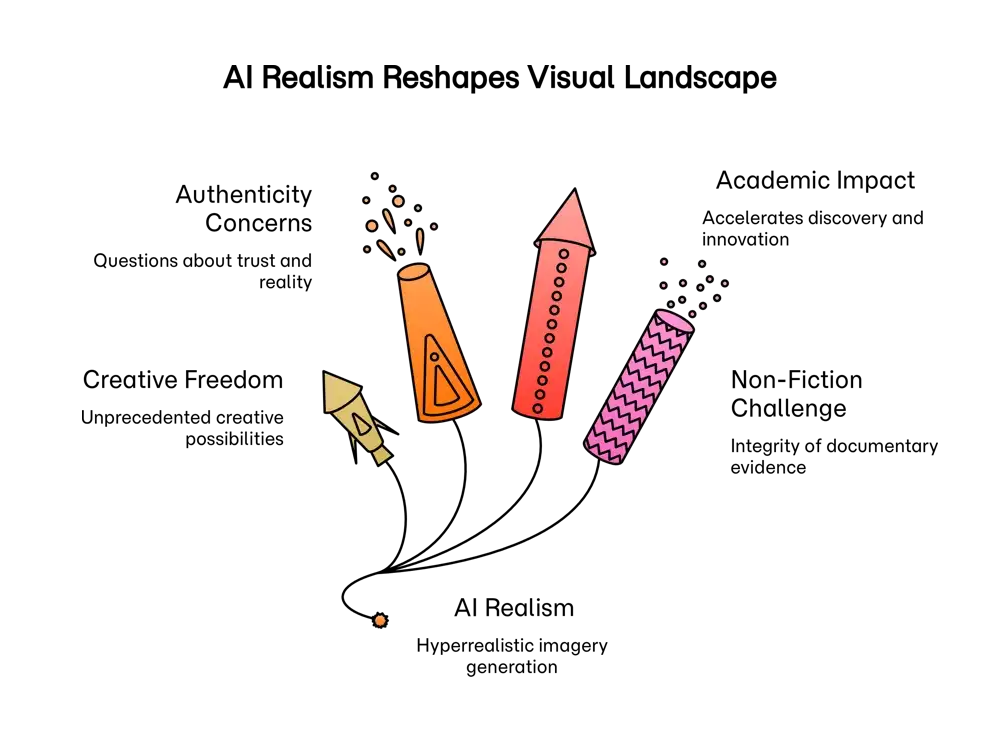
The rapid advancement of artificial intelligence in generating hyperrealistic imagery is profoundly reshaping the visual landscape. This technological evolution blurs the lines between the real and the synthetic, compelling a re-evaluation of the distinct potentials of traditional photography and AI-generated content. While generative AI offers unprecedented creative freedom, it also raises critical questions about authenticity and trust, particularly in fields reliant on factual representation like photojournalism. The impact extends into academic research and technological development, where AI-driven image analysis accelerates discovery but also demands new ethical frameworks. In the realm of non-fiction, the rise of realistic AI images challenges the integrity of documentary evidence, forcing a critical reassessment of how we create, consume, and verify visual information.