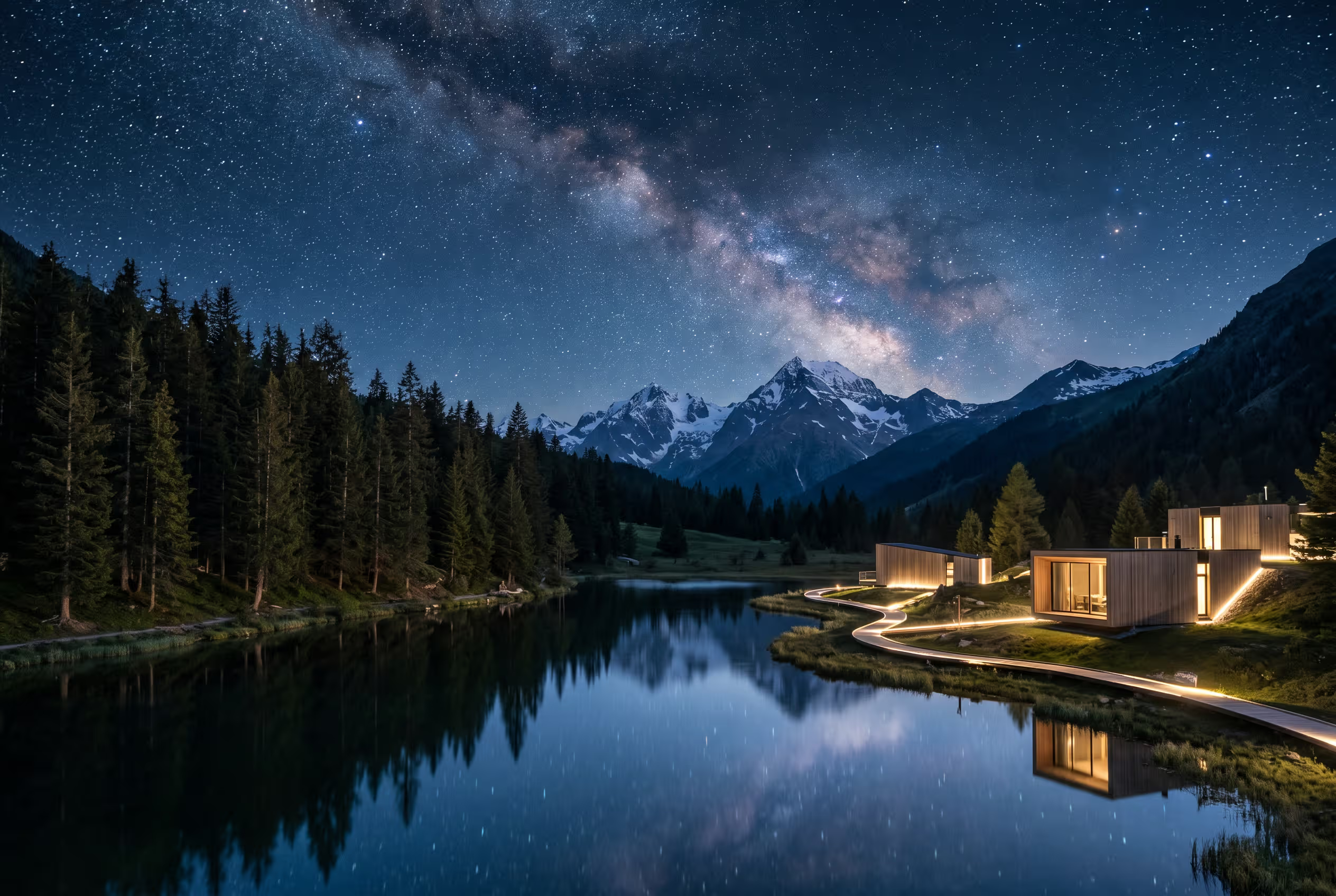
In the rapidly evolving world of artificial intelligence, image generators have achieved a remarkable ability to create visuals that are stunningly realistic. Yet, in their quest for perfection, they often stumble into a peculiar and unsettling phenomenon known as the "uncanny valley." This is the eerie sensation we feel when an artificial creation, be it a robot or a digital image, looks almost, but not exactly, human. A significant contributor to this effect is the tendency of AI to produce overly smooth or uniform textures, stripping away the natural imperfections that define reality. This issue has far-reaching implications across academic, technological, and non-fiction applications, where the line between authenticity and artificiality can impact trust, engagement, and comprehension.
The Origins and Psychology of the Uncanny Valley
The term "uncanny valley" was first introduced in 1970 by Japanese robotics professor Masahiro Mori. He hypothesized that as a robot's appearance becomes more humanlike, our emotional response to it becomes increasingly positive, until a point is reached where the resemblance is close but imperfect. At this stage, the positive feeling abruptly shifts to strong revulsion or eeriness. If the resemblance becomes virtually indistinguishable from a human, our positive response returns. This dip in affinity is the uncanny valley.
This psychological discomfort is rooted in several cognitive mechanisms. Theories suggest it stems from a "perceptual mismatch," where our brains detect conflicting cues for example, eyes that look realistic but skin that appears unnaturally smooth. This clash creates cognitive dissonance, an unsettling mental state that arises from holding contradictory perceptions. Our brains are finely tuned to understand prompt and recognize human faces and their subtle variations, so even minor deviations from the norm can trigger alarm. From an evolutionary perspective, this aversion may be a defense mechanism to avoid pathogens or those who are ill, or it may simply challenge our sense of human uniqueness.
The Technical Roots of AI's Flawless Finish
The reason many AI-generated images land in this uncanny territory often lies in the very processes used to create them. Modern generative AI, particularly those using diffusion models, work by starting with digital "noise" and gradually refining it into a coherent image based on a text-to-image prompt. During this "denoising" process, fine, random details that characterize natural surfaces like skin pores, subtle wrinkles, or the gentle irregularities of a fabric can be misinterpreted as unwanted noise and smoothed over. The result is a surface that is technically clean but appears flat and artificial, like plastic or wax.
Furthermore, AI model training involves analyzing vast datasets of existing images, much of which is sourced from the internet. This training data is often saturated with professionally edited, filtered, and airbrushed photographs where imperfections have already been removed to fit conventional beauty standards. The AI, therefore, learns that "perfection" and smoothness are desirable qualities and replicates them, creating a feedback loop of artificiality. Without a true three-dimensional understanding of how light interacts with complex surfaces, the AI approximates textures based on statistical patterns, leading to a generic, averaged appearance that lacks the unique character of realism.
Impact Across Diverse Applications
Academic and Educational Communication
In educational settings, the uncanny valley effect can be a significant barrier to learning. Studies on the use of virtual characters in e-learning have shown that hyper-realistic avatars can elicit feelings of eeriness, which in turn reduces student engagement and negatively impacts comprehension. When a learner's attention is diverted by the unsettling appearance of a digital instructor, their ability to absorb and retain information is diminished. For academic communication, such as in virtual conferences, avatars that fall into the uncanny valley can create a sense of discomfort that hinders natural interaction and trust.
| Academic Application | Effect of Overly Smooth Textures |
|---|---|
| Virtual Tutors/Avatars | Unnaturally perfect textures on avatars can feel eerie, reducing student engagement and trust in the virtual instructor. |
| Historical/Scientific Recreations | Flawless images can be perceived as less authentic, causing students to question the accuracy of the information presented. |
Technological and Medical Applications
The uncanny valley presents a challenge in various technological fields, including Virtual and Augmented Reality (VR/AR). An avatar with skin that lacks pores or a landscape with unnaturally uniform ground cover can break immersion and detract from the sense of presence. In medicine, AI-reconstructed images like MRIs that look "too clean" can cause unease among radiologists about their diagnostic reliability. Similarly, in the development of social robots and digital assistants, a "too-perfect" but flawed human appearance can make users less likely to trust or interact with the technology.
| Technological Application | Effect of Overly Smooth Textures |
|---|---|
| VR/AR Environments | Sterile, uniform textures on avatars and environments break immersion and can trigger feelings of unease, reducing the sense of realism. |
| Medical Imaging | AI-reconstructed scans that are "too clean" and lack natural noise can cause radiologists to feel uncertain about their diagnostic reliability. |
| Social Robots | A "too-perfect" yet flawed appearance can reduce user trust and interaction, limiting effectiveness in roles like customer service or elderly care. |
Non-Fiction and Media
For non-fiction content, where authenticity is paramount, the uncanny valley can severely damage credibility. AI tools capable of creating "fake" historical photographs or animating still images often produce results that are both fascinating and deeply unsettling. The subtle lack of realistic texture in authentic portraits reminds the viewer that what they are seeing is not real, which can lead to a broader erosion of trust in digital media. This is especially relevant as AI tools become more integrated into prompt for advertising and marketing, where consumer trust is essential.
| Non-Fiction Application | Effect of Overly Smooth Textures |
|---|---|
| Historical Photos/Illustrations | Polished and flawless depictions of historical figures or events can create suspicion about authenticity and damage the credibility of the work. |
| Social Media & Marketing | The use of uncanny AI-generated influencers or visuals can negatively impact viewers' body image and decrease trust in the brand or technology. |
Ready to transform your AI into a genius, all for Free?
Create your prompt. Writing it in your voice and style.
Click the Prompt Rocket button.
Receive your Better Prompt in seconds.
Choose your favorite AI model and click to share.
Summary of AI's Uncanny Valley
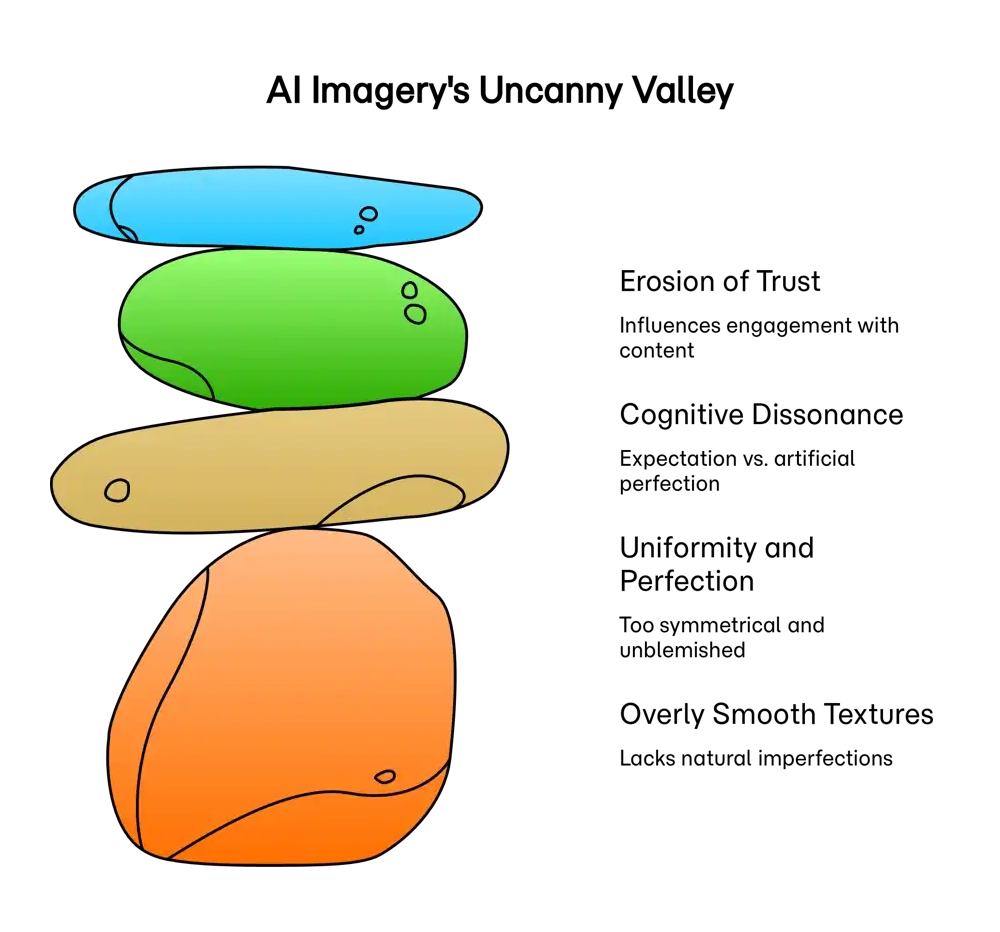
The uncanny valley in image generation describes the unsettling feeling viewers experience when an image is almost, but not quite, perfectly human or natural. A primary contributor to this phenomenon is the presence of overly smooth or uniform textures. Human perception is acutely aware of the natural imperfections in the world, such as the varied texture of skin or the subtle irregularities in wood. When AI models generate images that lack these natural flaws and instead present surfaces that are too perfect, it creates cognitive dissonance. This clash between our expectation of natural variance and the artificial perfection we observe is what triggers the eerie sensation, pushing the viewer into the uncanny valley. This effect carries significant implications, influencing our trust and engagement with content across educational, technological, and communicative applications.