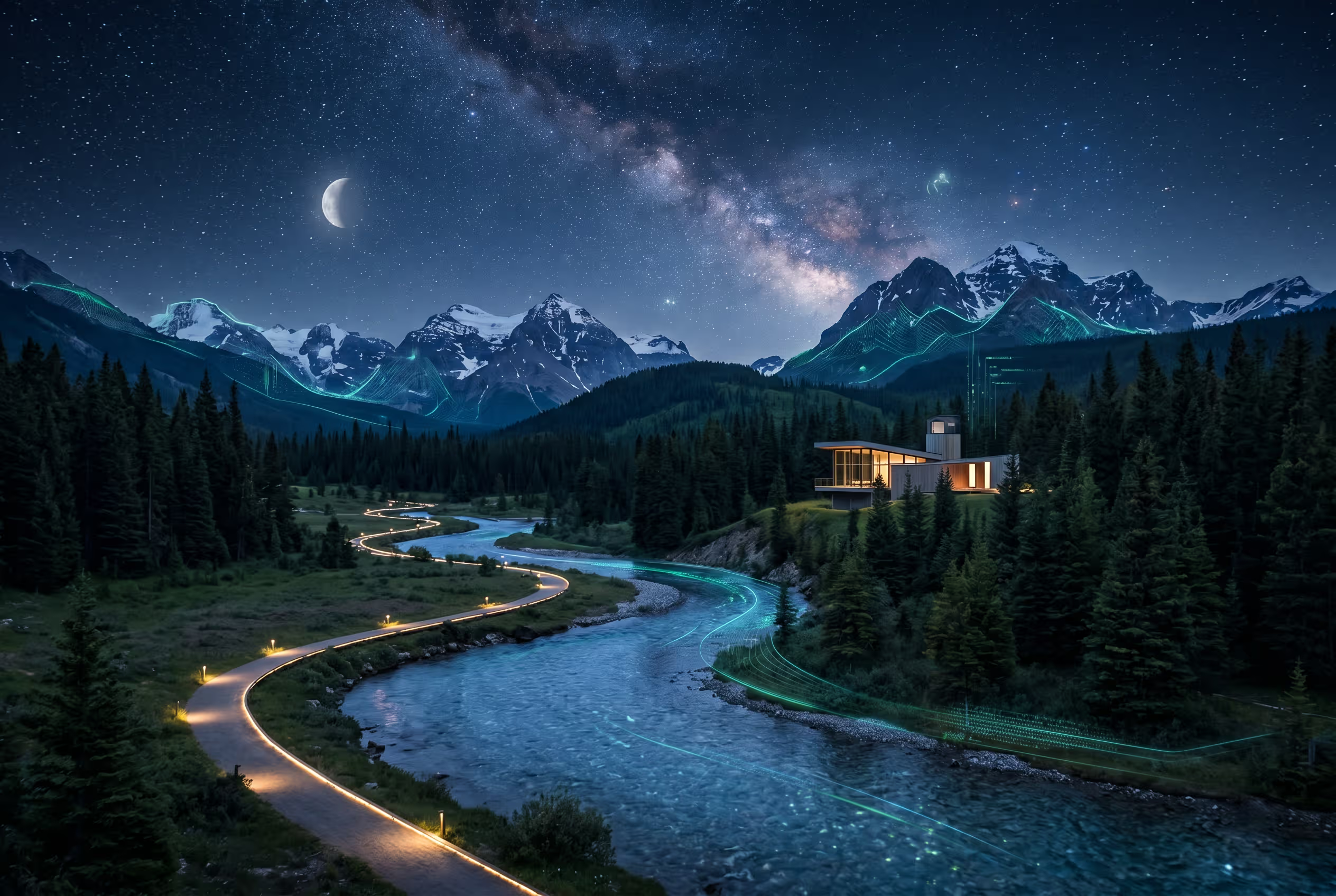
Naturalism as an artistic movement emphasizes the detailed and accurate representation of reality, a stark contrast to the idealized scenes of Romanticism. Emerging in the 19th century, it focused on depicting subjects in their natural environment with scientific precision, aiming to capture the world as it truly is, without embellishment. This philosophy found a powerful ally in photography, a medium capable of freezing reality with unparalleled accuracy. In the world of digital image generation, a modern form of this movement is taking shape, one that favors the gentle touch of technology over its heavy hand. This approach, "AI Naturalism," uses artificial intelligence to subtly enhance imagery, preserving the intricate textures and details that define a photograph's authenticity.
The Painter's Approach to AI
Consider a landscape painter from the Naturalist movement, meticulously capturing the transient effects of light on a mountain peak. Their goal was not to invent a perfect scene but to amplify the beauty already present. Similarly, AI Naturalism is not about fabricating reality but about enhancing it with a delicate touch. It's about using AI as a tool for realism, bringing out the inherent beauty of an image, revealing details that might have been lost, and correcting minor imperfections without sacrificing authenticity.
This contrasts with the common perception of AI-generated art, which can carry a hyperreal or surreal quality. The tell-tale signs of over-processing like unnaturally smooth skin, perfect symmetry, and an overall "plastic look" are precisely what practitioners of AI Naturalism seek to avoid, steering clear of the uncanny valley. The focus is on maintaining the original character and texture of the image, celebrating its imperfections as part of its story.
The Tools of the Trade
A variety of AI-powered tools are now available that allow for this level of nuanced control through thoughtful prompt engineering. These tools are not about creating images from scratch but about refining existing ones. Techniques such as AI-powered denoising can remove unwanted grain from a photograph taken in low light, while preserving the fine details of the subject. Super-resolution algorithms can increase the size of an image, not by simply stretching it, but by intelligently filling in missing details to maintain sharpness and clarity.
Targeted adjustments are key. Instead of applying a one-size-fits-all filter, AI can analyze an image's content to make intelligent corrections. AI-powered masking tools can identify and select specific elements within a photograph like the sky, a person, or a body of water allowing for adjustments that once required hours of manual labor. This allows an artist to enhance one part of an image, a practice similar to inpainting, without altering the rest.
Enhancing Detail and Texture
Preserving and enhancing an image's texture is fundamental to achieving a natural look. AI can sharpen micro-textures to make materials feel more tactile and real. The goal is to improve clarity while respecting the original character of the photograph.
| Technique | Description |
|---|---|
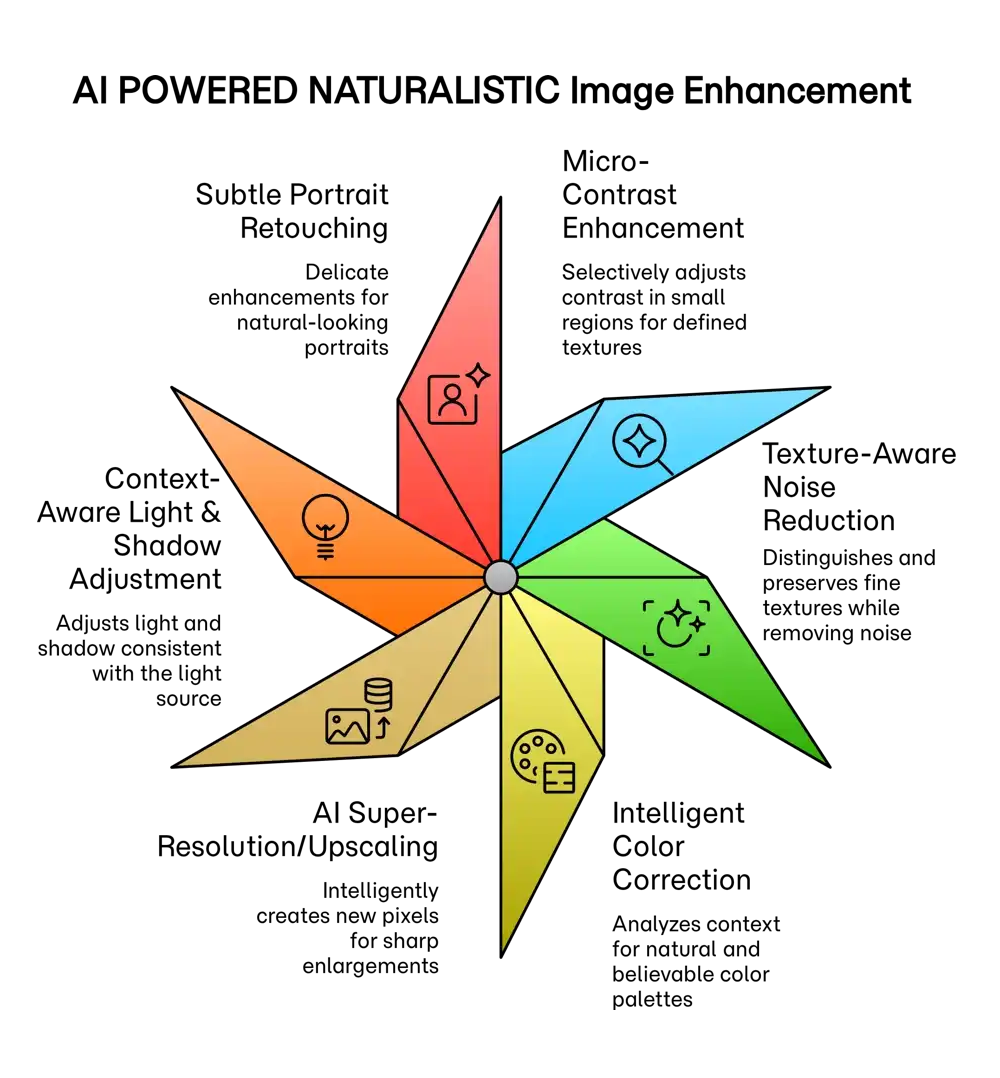
| Micro-Contrast Enhancement | AI algorithms can analyze and selectively adjust the contrast in small regions of an image, which enhances texture and detail without affecting the overall tonal balance, making surfaces appear more defined and realistic. |
| Texture-Aware Noise Reduction | Instead of uniformly blurring an image to remove grain, AI can distinguish between unwanted noise and fine textures, such as wood grain or fabric weave, preserving the latter while cleaning up the former. |
| AI Super-Resolution/Upscaling | When a higher resolution is needed, AI can upscale an image by intelligently creating new pixels based on its analysis of surrounding detail. This allows for enlargements that maintain sharp edges and realistic textures, serving as a powerful quality improvement prompt. |
Refining Light and Color
Light and color are the soul of a photograph. AI tools can make sophisticated adjustments that mimic the properties of natural light, ensuring the final image is vibrant but believable.
| Technique | Description |
|---|---|
| Intelligent Color Correction | AI can correct color casts and enhance vibrancy by analyzing the image's context. It understands that a sunset should have warm tones while a forest should have earthy greens, ensuring a natural color palette. |
| Context-Aware Light & Shadow Adjustment | AI can identify the primary light source in a photograph and make subtle adjustments to highlights and shadows that are consistent with that source, adding a sense of depth and realism. |
Specialized Applications
Beyond general enhancements, AI offers specialized tools for common photographic subjects like portraits and landscapes, where maintaining a natural feel is paramount.
| Technique | Description |
|---|---|
| Subtle Portrait Retouching | In authentic portraits, AI can perform delicate enhancements such as reducing blemishes while preserving skin pores and texture, or whitening teeth and enhancing eye clarity without creating an unnatural look. This is a key function of a modern retouching prompt. |
| Landscape Enhancement | For landscapes, AI can enhance foliage, define clouds, and improve the clarity of water, all while maintaining the scene's natural color and light relationships. |
Preserving the Essence of the Image
The key to AI Naturalism lies in its philosophy of restraint. It is an acknowledgment that perfection is often found in the imperfect. By embracing the subtle variations and textures of the natural world, photographers and artists can use generative AI not to create a false reality, but to present a more vivid and engaging version of our own. It's a collaboration between human creativity and machine intelligence, with the artist guiding the AI's hand to achieve a result that is both beautiful and believable.
As AI technology continues to evolve, the potential for this kind of subtle, naturalistic enhancement will only grow. The painter's brush is no longer limited to bristles and pigment; it has expanded to include the sophisticated algorithms of artificial intelligence. But the goal remains the same: to capture the world in all its detailed, textured, and imperfect glory.
Ready to transform your AI into a genius, all for Free?
Create your prompt. Writing it in your voice and style.
Click the Prompt Rocket button.
Receive your Better Prompt in seconds.
Choose your favorite AI model and click to share.
Summary of Naturalism and the 'AI look'
Naturalism is an artistic philosophy dedicated to portraying the world with unadorned truth and accuracy. In modern photo editing prompt, this translates to using artificial intelligence as a master tool for subtle refinement rather than overt alteration. Instead of creating an artificial "AI look," modern AI editing tools can make microscopic adjustments that respect and preserve a photograph's original textures and details. This nuanced approach involves the AI analyzing the image to understand its content, allowing for targeted enhancements like selectively brightening a subject's eyes or enhancing contrast in a distant mountain range. This is akin to a painter knowing precisely where to add a speck of white to create a glint of light. The key is the AI's ability to differentiate between noise and texture, correct colors based on natural light, and upscale images by intelligently reconstructing details rather than simply stretching pixels.