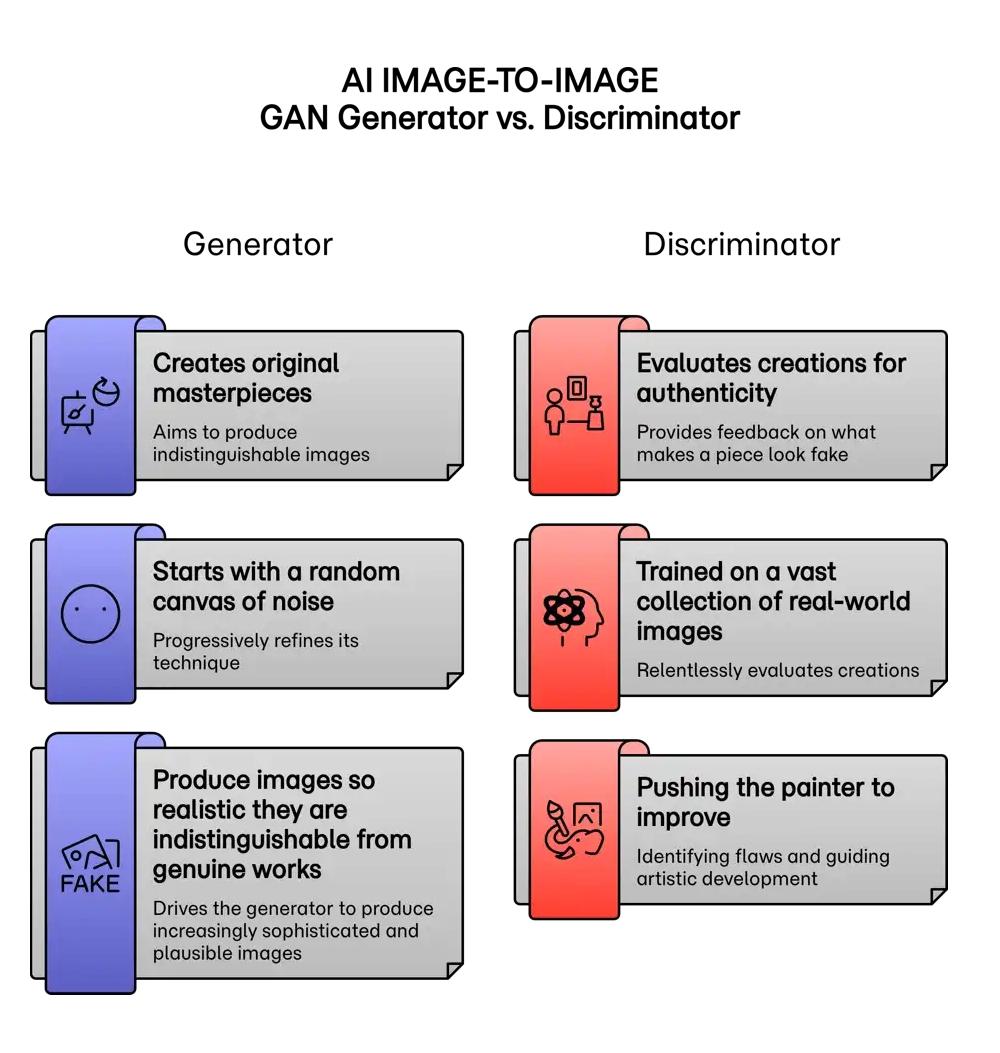
In the world of generative AI, a powerful technology known as image-to-image prompt Generative Adversarial Networks (GANs) is enabling remarkable transformations. This technique involves converting an image from a source style to a target style, such as turning a satellite photo into a map, a black-and-white image to color, or a sketch into a realistic photograph. At its core, this technology can be visualized as a timeless duel between a master painter, the 'Generator,' and a discerning art critic, the 'Discriminator.' This dynamic duo works in a constant cycle of creation and evaluation to produce new visual masterpieces.
The Creative Duel: Generator vs. Discriminator
Imagine a painter who is also a masterful forger. This painter, our Generator, is tasked with transforming an input image say, a simple line drawing of a building into a photorealistic final product. Initially, its attempts are crude. This is where the art critic, our Discriminator, steps in. The critic's role is to distinguish between the painter's forgeries and real, authentic photos of buildings. By providing feedback on what makes an image look fake, the critic pushes the painter to refine its technique. This adversarial process continues, with the painter becoming increasingly skilled at creating convincing images and the critic becoming more adept at spotting fakes. Eventually, the painter's creations become so realistic that they are virtually indistinguishable from the real thing, at which point the GAN is successfully trained.
| Component | Analogy | Function in Image-to-Image GANs |
|---|---|---|
| Generator | The Painter | Takes a source image like a sketch and attempts to transform it into a target image like a photo. It learns to produce increasingly realistic outputs based on the discriminator's feedback. |
| Discriminator | The Art Critic | Compares the generator's output to real images from the target domain and determines if the generated image is "real" or "fake." This feedback guides the generator's learning process. |
Approaches to Image Translation
Image-to-image translation can be broadly categorized into two main approaches, depending on the type of data available for model training.
Paired Image Translation (Supervised)
This method requires a training dataset of "paired" images, where a direct, one-to-one correspondence exists between the source and target images. For example, a dataset might contain thousands of pairs of architectural sketches and their corresponding final photographs. The popular pix2pix model is a conditional GAN (cGAN) designed for these tasks. The generator is "conditioned" on the input image, using it as a direct guide to create the translated output.
| Paired Translation Task | Source Domain | Target Domain |
|---|---|---|
| Labels to Photo | Semantic Segmentation Map | Photorealistic Scene |
| Black & White to Color | Grayscale Image | Color Image |
| Maps to Satellite | Street Map | Aerial Photograph |
Unpaired Image Translation (Unsupervised)
Often, obtaining paired data is difficult or impossible. For instance, you might have a collection of Monet paintings and a collection of landscape photographs, but no direct painting-to-photo pairs. This is where unpaired translation methods shine. CycleGAN is a well-known model for this task. It uses an ingenious technique called cycle-consistency loss. The model learns to translate an image from domain A to B, and then back from B to A, ensuring the result is close to the original image. This allows it to learn the translation without direct pairs, enabling applications like neural style transfer.
| Unpaired Translation Task | Source Domain | Target Domain |
|---|---|---|
| Style Transfer | Photograph | Van Gogh Painting |
| Object Transfiguration | Horse | Zebra |
| Season Transfer | Summer Scene | Winter Scene |
Revolutionizing Research and Visualization
The painter and critic analogy extends beautifully into academic research, where image-to-image GANs offer innovative solutions. A significant application is in data augmentation and translation. In medical imaging, for example, a GAN can be trained to translate MRI scans into CT scans, or vice-versa, creating valuable data for training diagnostic AI models when one imaging modality is scarce. This process helps overcome data limitations and privacy concerns, accelerating medical research. Furthermore, GANs are a powerful tool for scientific visualization, translating complex data like spectral images from satellites into more intuitive, natural-looking images that are easier for scientists to interpret and communicate.
Transforming Creative and Educational Content
In education and creative fields, the GAN framework is being used to produce a new generation of engaging visual materials. A history lesson can be enhanced by using a GAN to colorize historical black-and-white photographs, providing students with a more tangible connection to the past. For art and design, a GAN can turn simple sketches into photorealistic images, serving as a powerful image-to-image prototyping tool. This technology acts as a tireless "painter," generating a wide array of visual aids to make learning more effective. The "critic" ensures the output is not just visually appealing but also accurate, which is vital for avoiding the spread of misinformation.
Ready to transform your AI into a genius, all for Free?
Create your prompt. Writing it in your voice and style.
Click the Prompt Rocket button.
Receive your Better Prompt in seconds.
Choose your favorite AI model and click to share.
Summary of Image-to-Image GANs
Image-to-Image translation with Generative Adversarial Networks (GANs) is a technique in machine learning used to transform an image from one domain to another. It operates on a competitive dynamic between two neural networks: a generator and a discriminator. The generator ("the painter") learns to translate a source image into a target style, while the discriminator ("the art critic") learns to distinguish the generator's creations from real images. This adversarial process pushes the generator to create highly realistic translations. Key methods include paired translation (like pix2pix), which uses directly corresponding images for training, and unpaired translation (like CycleGAN), which can learn mappings without one-to-one examples. This technology has wide-ranging applications, from scientific visualization and data augmentation to creative tools and educational content.
Frequently Asked Questions
What is AI image-to-image generation?
What is the difference between inpainting and outpainting?
How can I maintain a consistent character or style across multiple images?
Can AI improve the quality of my low-resolution photos?
What is ControlNet and how does it relate to image-to-image generation?
What are some practical applications of image-to-image AI?
- Interior Design: Visualizing different styles in an existing room.
- Product Mockups: Placing a product into various scenes and styles for marketing.
- Photo Editing: Removing unwanted objects, restoring old photos, or changing the style.
- Art and Creativity: Transforming sketches into finished artworks or applying the style of one artist to another's image.
- Prototyping: Quickly creating visual concepts for products and designs.