
Artificial intelligence has revolutionized visual content creation, and one of the most powerful techniques is using a reference image to guide the generation process. This method, often called an image-to-image prompt, allows users to provide an existing visual like a photo, sketch, or brand asset to influence the final output. The AI analyzes the reference for key elements and combines that information with a text prompt, offering far more control than text alone. This allows for the precise replication of artistic styles, compositional layouts, and character features, with wide-ranging applications in creative, professional, and academic fields.
Core Techniques: How AI Uses Reference Images
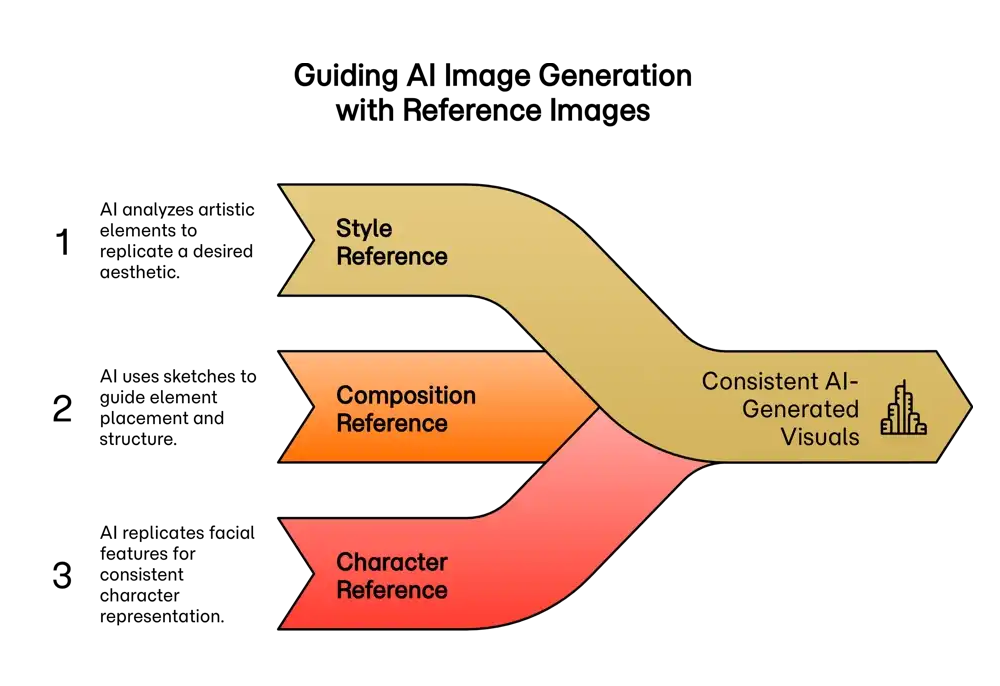
Guiding an AI with a reference image involves providing one or more images to influence the final output. The AI analyzes these references for specific qualities, which can be broadly categorized into three main techniques: style replication, compositional guidance, and maintaining subject likeness. These methods allow for a high degree of control over the generated visuals.
Style Replication (Style Transfer)
Style replication, also known as neural style transfer, is used to mimic the aesthetic of a reference image. The AI analyzes qualities like color palettes, lighting, textures, and brush strokes and applies this "style" to a new image generated from a text prompt. This is ideal for creating a cohesive series of images or applying a specific artistic feel, such as watercolor or 3D rendering, to a new subject. When choosing a style prompt, providing a reference image gives the AI a clear visual target to match.
| Capability | Description | Applications |
|---|---|---|
| Style Replication | The AI analyzes a reference image to understand its artistic qualities, such as color, texture, and lighting, and applies this aesthetic to a new image. | Maintaining brand consistency, creating a cohesive series of illustrations, applying artistic effects like watercolor, oil painting to new subjects. |
Compositional Guidance
A reference image can serve as a blueprint for the structure and layout of a new visual. By providing a photo or even a simple sketch, a user can dictate the framing, posing, and arrangement of elements in the generated image. The AI creates a structural map from the reference, ensuring that subjects and objects in the new image are placed in a similar manner. This is invaluable for tasks like image-to-image prototyping, where pre-visualizing a specific layout is essential.
| Capability | Description | Applications |
|---|---|---|
| Compositional Guidance | Users provide a reference image or sketch to dictate the layout, framing, and posing of subjects. The AI uses this as a structural blueprint. | Storyboarding for film, planning photoshoots, creating product mockups with consistent layouts, and architectural visualization. |
Maintaining Subject Likeness
One of the biggest challenges in AI generation is character consistency. Reference images solve this by allowing the AI to lock onto a subject's key features. By using a photo of a person, the model can generate new images of that same individual in different scenes, outfits, or styles. Some platforms can even use multiple reference images of a subject to build a more robust and accurate model, which is crucial for creating authentic portraits and exploring digital representation and digital identity.
| Capability | Description | Applications |
|---|---|---|
| Subject Likeness | The AI uses a reference photo to preserve a person's or character's facial features and key identifiers across newly generated images. | Developing consistent characters for comics or games, creating personalized avatars, generating diverse portraits of an individual for professional use. |
Applications in Diverse Fields
Academia and Education
In academia, researchers can use reference images to create polished figures for publications. A hand-drawn diagram can be transformed into a professional-looking illustration that matches a journal's style. Educators can use historical photos as style references to generate new scenes for history lessons, or language teachers can create visual aids illustrating verb tenses by showing a consistent character performing different actions. This allows for a high degree of prompting for complexity and nuance in educational materials.
Business and Marketing
For businesses, maintaining brand consistency is crucial. Reference images are powerful tools for this. A company can use its logo, color palette, and existing brand photography as style references to generate new visuals for social media, websites, and advertisements. This allows a marketing team to create a wide range of on-brand content, from professional head shots prompt to product mockups, ensuring a cohesive look and feel. This is especially useful for small businesses prompt looking to create high-quality marketing materials efficiently and for larger campaigns that require a strong prompt for marketing and prompt for advertising.
General Creative Expression
For artists and designers, reference images unlock a world of creative possibilities. An illustrator can use a rough sketch as a compositional reference to quickly generate detailed and colored versions of a concept. Character designers can maintain consistency across various poses and expressions. This technology also enables creative prompting by blending styles, such as applying the color palette of a famous painting to a modern photograph to achieve a high degree of realism prompt or creating symbolic imagery prompt. It fosters a collaborative process between human creativity and machine efficiency.
Ready to transform your AI into a genius, all for Free?
Create your prompt. Writing it in your voice and style.
Click the Prompt Rocket button.
Receive your Better Prompt in seconds.
Choose your favorite AI model and click to share.
Summary of Reference Images in AI Generation
AI image generators can be guided by reference images to create a wide variety of visuals while maintaining the likeness of a specific subject and a desired compositional style. This method provides greater control over the final output than text prompts alone. To achieve this, users can provide one or more reference images to influence different aspects of the generation. For instance, to maintain a consistent aesthetic, a "style" reference can be used; the AI analyzes the artistic elements of the reference, such as its color palette, lighting, and texture, and applies this style to the new image. This is particularly useful for creating a series of images with a cohesive look or maintaining brand consistency. To control the structure and arrangement of elements, a "composition" or "layout" reference can be used, which can even be a simple sketch. This guides the AI in placing subjects and objects within the frame, dictating the pose, and defining the overall structure. Furthermore, to ensure a person or character remains recognizable, a "character" reference can be utilized. The AI focuses on replicating facial features and other key characteristics, allowing for the creation of consistent characters across different scenes, outfits, or artistic styles, a feature invaluable for storytelling in comics, games, or marketing campaigns.