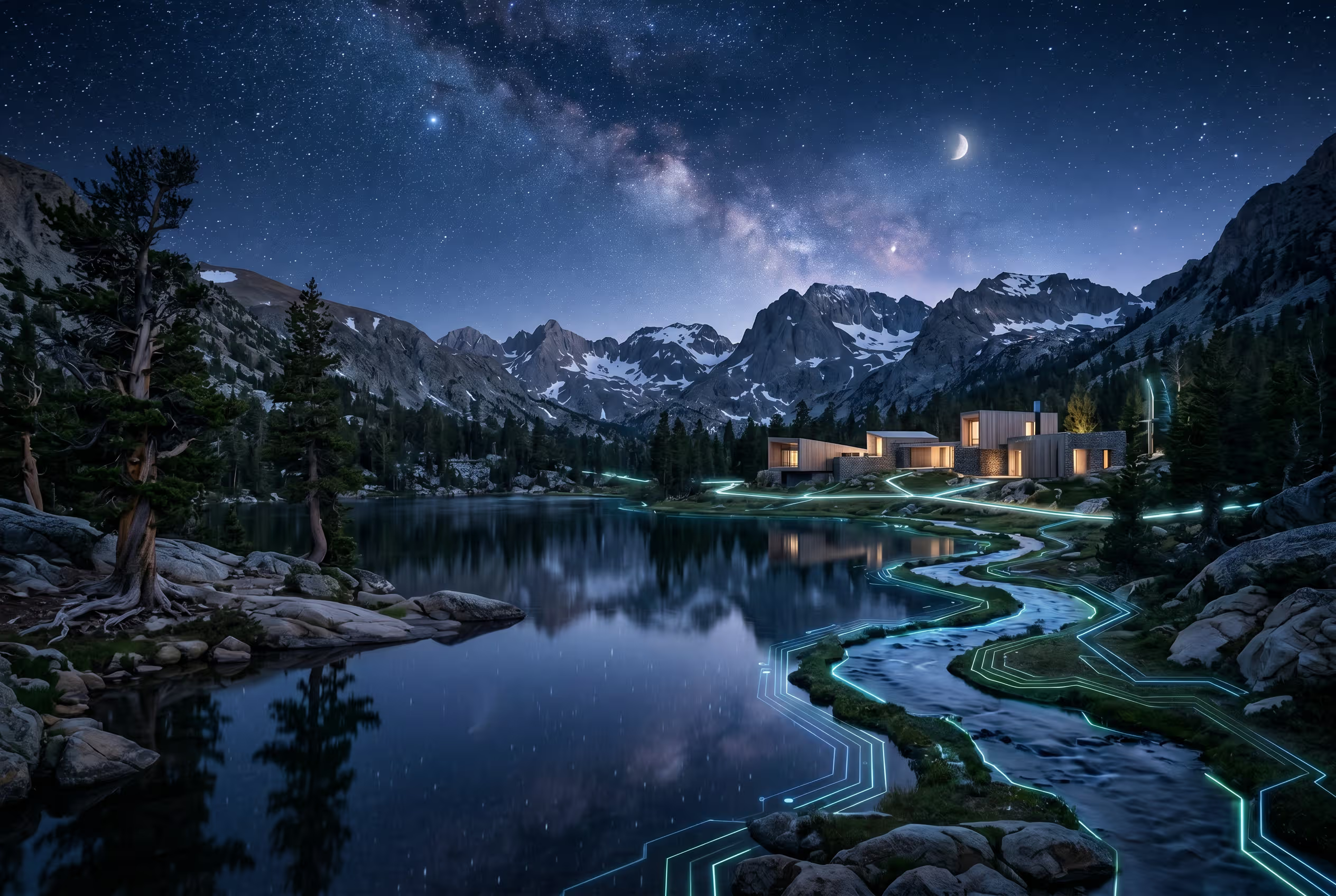
Unveiling a New Form of Digital Creativity
Imagine taking a photograph and seamlessly repainting it in the style of a famous artist like Vincent van Gogh or Pablo Picasso. This transformative process, known as AI Image Neural Style Transfer (NST), is a creative application of generative AI that allows for the creation of novel visual works. By merging the artistic essence of one image with the subject matter of another, this sophisticated machine learning technique has unlocked new avenues for artistic expression, academic research, and innovative problem solving.
The Artistic Alchemy: How Neural Style Transfer Works
At its core, Neural Style Transfer is an optimization process that blends two reference images: a "content" image and a "style" image, to generate a new, third image. The goal is for the output image to retain the recognizable content of the first image while adopting the color palette, textures, and brushstrokes of the second.
This remarkable feat is achieved using a pre-trained Convolutional Neural Network (CNN), a type of deep learning model adept at processing and understanding visual data. A popular choice for this task is the VGG-19 network, which was originally trained for object recognition on a massive dataset of images.
Separating Content and Style
The magic of NST lies in the ability of CNNs to distinguish between an image's content and its style. As an image is processed through the layers of a CNN, the network extracts features at different levels of abstraction. The earlier layers of the network are skilled at identifying basic features like edges and textures, while the deeper layers recognize more complex, high-level content such as object shapes and their arrangement.
To capture the artistic flair of the style image, a representation known as the Gram matrix is computed. This matrix measures the correlations between different features at various layers of the CNN, encapsulating the textures and patterns that define the style without being tied to the specific objects in the image.
The Merging Process
The generation of the new image is an iterative process that starts with an initial image (often random noise or a copy of the content image). This image is then systematically adjusted to minimize two distinct loss functions simultaneously:
- Content Loss: This function calculates the difference between the high-level feature representations of the generated image and the original content image. A lower content loss means the generated image more closely resembles the structure and objects of the content image.
- Style Loss: This function measures the discrepancy between the style representations (the Gram matrices) of the generated image and the style reference image. A lower style loss indicates that the generated image has successfully captured the artistic texture and patterns of the style image.
Through optimization, the pixels of the generated image are adjusted to reduce both losses, resulting in a harmonious blend that marries the "what" of one image with the "how" of another.
| Step | Description |
|---|---|
| 1. Input | Two images are selected: a Content Image (providing the subject) and a Style Image (providing the artistic texture and palette). |
| 2. Feature Extraction | A pre-trained CNN extracts content features (from deeper layers) and style features (from multiple layers) of both input images. |
| 3. Image Generation | A new image is generated and iteratively modified to minimize both content loss (difference from the content image) and style loss (difference from the style image's Gram matrices). |
| 4. Output | The final result is a Generated Image that combines the structure of the content image with the aesthetic of the style image. |
Diverse Applications of Neural Style Transfer
The impact of Neural Style Transfer extends far beyond digital art, finding practical and innovative applications in various fields.
A New Canvas for Artistic Expression
For artists and creators, NST offers a powerful tool for experimentation and inspiration. It allows for the rapid prototyping of different stylistic approaches and the creation of unique hybrid aesthetics. Photographers and digital artists use it to apply unique visual styles to their work, while designers can experiment with new patterns and textures.
Advancing Academic and Scientific Research
In the academic world, NST is a tool for research, particularly in data augmentation. By applying different styles to an existing dataset like making road images appear "rainy" or "night-time," researchers can artificially expand the diversity of their training data. This helps in training more robust machine learning models, such as those for autonomous vehicles, to generalize better to unseen scenarios. In fields like microscopy, NST can enhance the visualization of cellular structures.
Commercial and Innovative problem solving
The principles of style transfer are also being applied to creative problem solving in business.
- Design & Prototyping: In interior design and architecture, designers can use NST to quickly visualize a space with various material finishes and stylistic themes.
- Entertainment & Gaming: It can be used for the rapid stylization of video game environments or for applying a consistent artistic look across scenes in film and animation.
- Marketing & Advertising: Brands can create unique, eye-catching visuals for campaigns that align with a specific aesthetic, saving time and effort.
NST in the Landscape of Generative AI
While NST is a powerful technique, it's part of a broader family of generative models. Other methods like Generative Adversarial Networks (GANs) and diffusion models have also revolutionized image generation. For instance, CycleGAN, a type of GAN, can perform image-to-image translation without needing paired images, meaning it can learn to turn summer scenes into winter ones by training on a collection of summer and winter photos. While NST is ideal for applying a specific style from one image to another, GANs and diffusion models often provide more flexibility for general image-to-image translation tasks.
Frequently Asked Questions
What is AI image-to-image generation?
What is the difference between inpainting and outpainting?
How can I maintain a consistent character or style across multiple images?
Can AI improve the quality of my low-resolution photos?
What is ControlNet and how does it relate to image-to-image generation?
What are some practical applications of image-to-image AI?
- Interior Design: Visualizing different styles in an existing room.
- Product Mockups: Placing a product into various scenes and styles for marketing.
- Photo Editing: Removing unwanted objects, restoring old photos, or changing the style.
- Art and Creativity: Transforming sketches into finished artworks or applying the style of one artist to another's image.
- Prototyping: Quickly creating visual concepts for products and designs.