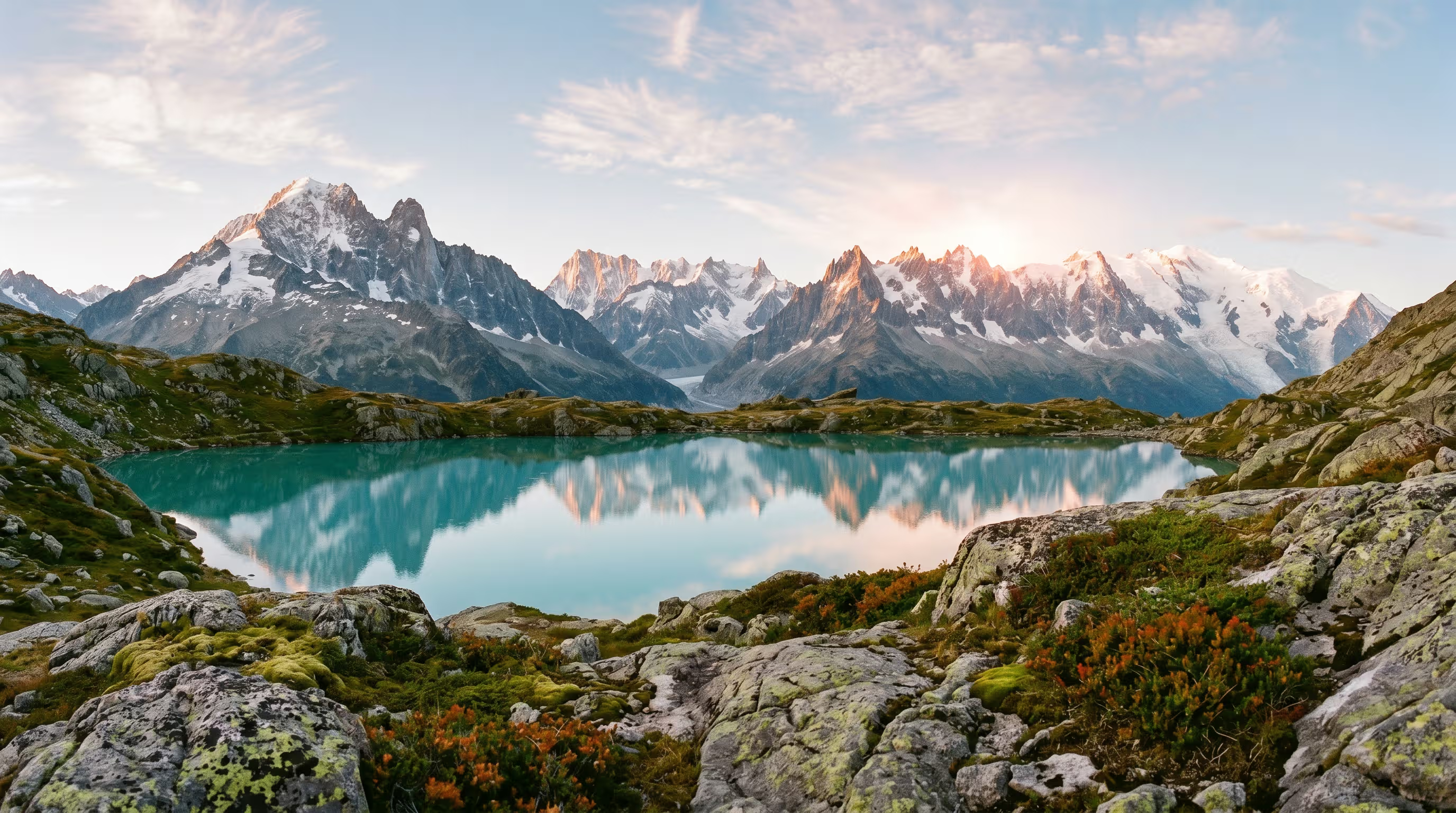
Art has long served as a profound medium for expressing the vast and often wordless spectrum of human emotion. Now, a new creator has entered the studio: Artificial Intelligence. This has given rise to "AI Image Abstraction," a burgeoning field where algorithms are employed to generate abstract visual art that can interpret and convey a wide range of human emotions and experiences. Unlike traditional art, AI-generated art leverages machine learning models to produce unique and often unpredictable designs.
The Algorithmic Muse: How AI Understands Abstraction
The ability of AI to create abstract art is rooted in its capacity to process and reinterpret vast amounts of visual information. By training on large datasets of existing artworks, artificial neural networks can learn to identify the underlying patterns, styles, and relationships between visual elements. This process enables the generation of new compositions that adhere to the principles of abstraction while introducing novel forms. Key technologies driving this revolution include GANs (Generative Adversarial Networks) and, more recently, diffusion models. GANs operate by using two competing neural networks a generator and a discriminator to progressively refine images until they are convincingly novel.
Translating Emotion into Pixels
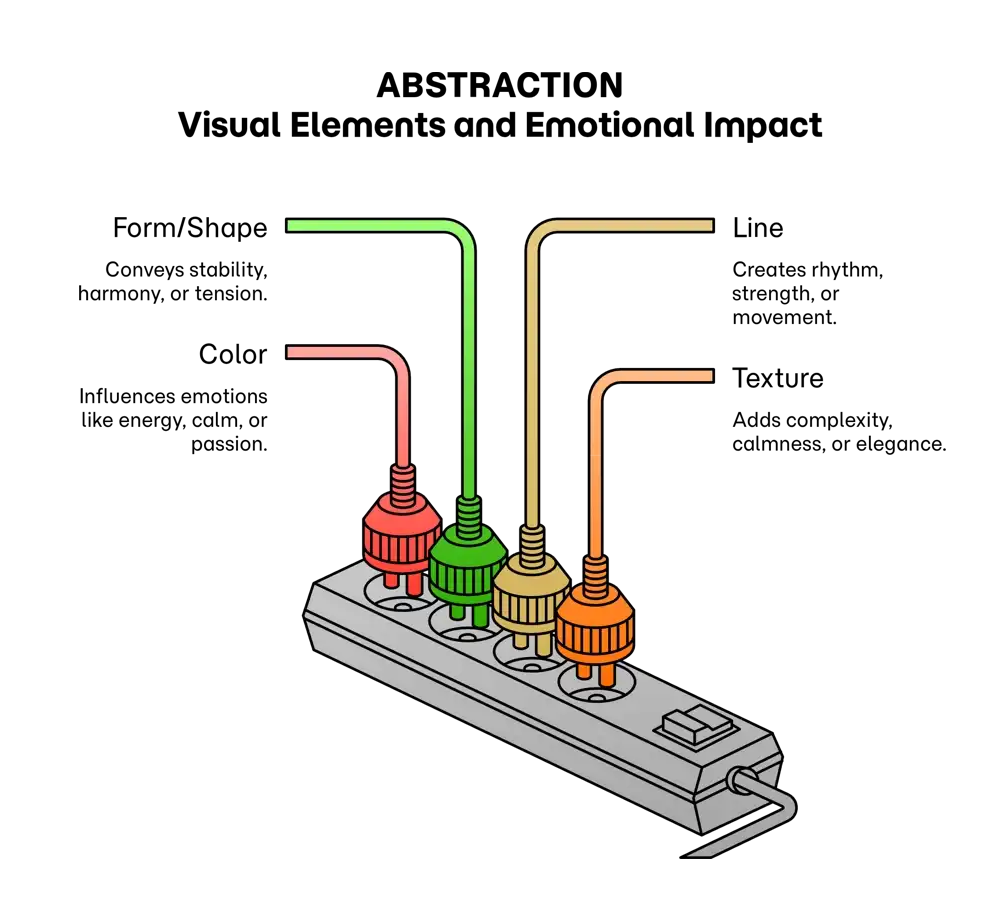
The core challenge of AI image abstraction lies in translating a deeply human, often ambiguous, emotional concept into a set of instructions a machine can understand. This is achieved through a sophisticated understanding of color and form, guided by detailed prompt engineering.
The Role of Color in Evoking Emotion
Color is a powerful tool for influencing mood, and AI models can be guided to use color psychology to create a specific atmosphere. While AI doesn't "see" color like humans, it interprets it conceptually based on patterns from its training data. For instance, a text-to-image prompt for "joy" might result in the AI generating images with warm, vibrant colors like yellows and oranges, which it associates with happiness and energy. In contrast, a prompt for "sadness" would likely yield cool tones like blues and greens. Effective prompting can even specify color harmonies like "analogous" or "complementary" to achieve a more balanced and aesthetically pleasing result.
| Emotion Prompt | Common AI Visual Interpretation (Colors & Forms) |
|---|---|
| Joy / Happiness | Bright, warm colors (yellows, oranges); Flowing, upward-curving lines; Organic shapes. |
| Sadness / Melancholy | Cool, muted colors (blues, grays); Dripping or descending lines; Soft, undefined forms. |
| Anger / Tension | Harsh, contrasting colors (reds, blacks); Sharp, jagged, and angular lines; Chaotic compositions. |
| Calm / Peace | Soft, cool, and neutral palettes (greens, blues, beiges); Smooth, horizontal lines; Simple, geometric shapes. |
Form and Shape: The Structure of Feeling
Alongside color, form and shape are crucial in building the emotional landscape of an artwork. AI algorithms analyze and interpret form by identifying shapes, lines, and contours in an image. Sharp, angular, and symbolic geometric shapes can communicate tension, structure, or stability, while soft, organic, and curved forms often suggest harmony, fluidity, and peace. An experiment testing single-word emotional prompts with various AI tools revealed that each tool has a distinct stylistic interpretation, ranging from photorealistic to surreal and abstract. This demonstrates that the AI's underlying architecture heavily influences how it translates an abstract concept into a visual form.
The Human-AI Collaborative Process
The future of AI in art is not about replacing the human artist but about augmenting creativity through collaboration. This partnership relies on the skill of a prompt engineer to guide the AI. The process is often one of prompt iterative refinement, where a creator starts with a simple idea and progressively adds layers of detail to steer the AI toward the desired vision. This might involve using negative prompting to remove unwanted elements or specifying a particular artistic style. This human in the loop approach ensures that the final output is a blend of machine precision and human intention.
| Model Type | How It Works | Typical Abstract Style |
|---|---|---|
| GANs (Generative Adversarial Networks) | A "generator" network creates images, and a "discriminator" network judges them, forcing the generator to improve. | Can be highly variable; early models produced more surreal and dreamlike imagery. |
| Diffusion Models | Starts with random noise and gradually refines it into an image that matches a text prompt. | Often produces more coherent, detailed, and stylistically controlled abstract art. |
The Future of Aesthetic Expression
While some studies show that viewers may feel less awe towards art they believe is AI-created, the technology's role is rapidly evolving from a simple tool to a creative partner. Researchers are working to create a more nuanced language for artists to communicate their vision to AI, moving beyond simple text. As generative AI continues to develop, it will undoubtedly open new avenues for exploring and expressing the depths of our emotions, transforming our creative and aesthetic environments.
Ready to transform your AI into a genius, all for Free?
Create your prompt. Writing it in your voice and style.
Click the Prompt Rocket button.
Receive your Better Prompt in seconds.
Choose your favorite AI model and click to share.
Summary of AI Image Abstraction
AI Image Abstraction uses generative AI to translate human emotions and complex concepts into abstract art. By analyzing vast datasets, AI models like GANs and diffusion models learn the associations between visual elements and ideas. Through a process of prompt engineering, creators guide the AI to use specific colors, forms, and compositions to evoke feelings like joy with warm colors or tension with sharp lines. This collaborative process, which often involves iterative refinement and a human in the loop, is not about replacing artists but augmenting their creative potential. The result is a powerful new medium for expression that merges human vision with algorithmic precision.
| Technique | Description | Example Prompt Fragment |
|---|---|---|
| Emotional Prompting | Using evocative, feeling-focused words to guide the overall mood and atmosphere of the image. | "An abstract image representing the feeling of serenity..." |
| Style Specification | Referencing specific art movements or artists to steer the AI's stylistic interpretation. | "...in the style of Abstract Expressionism, like Mark Rothko." |
| Negative Prompting | Specifying what to exclude from the image to refine the output and remove unwanted elements. | "...--no figurative elements, no people, no objects." |
| Compositional Cues | Describing the arrangement of elements, such as lines and shapes, to control the visual structure. | "...with clean geometric lines and a minimalist composition." |