
The rise of artificial intelligence has ushered in a new era of digital creation, with text-to-image generation standing out as a particularly transformative technology. Tools like Midjourney, DALL-E, and Stable Diffusion are empowering users to create a vast array of visuals, from hyper-realistic photographs to surrealist art, simply by inputting a textual description. This text-based instruction is known as a prompt, and it serves as the bridge between human imagination and the AI's execution. However, the true potential of this technology lies not just in its accessibility, but in the nuanced skill of prompt engineering. The art and science of writing effective prompts is crucial for guiding AI models to produce the desired output. The quality and specificity of the visual output are directly proportional to the clarity and detail of the prompt. Understanding these intricacies is paramount for enhancing visual outputs across creative, academic, and commercial applications.
The Anatomy of an Effective Prompt
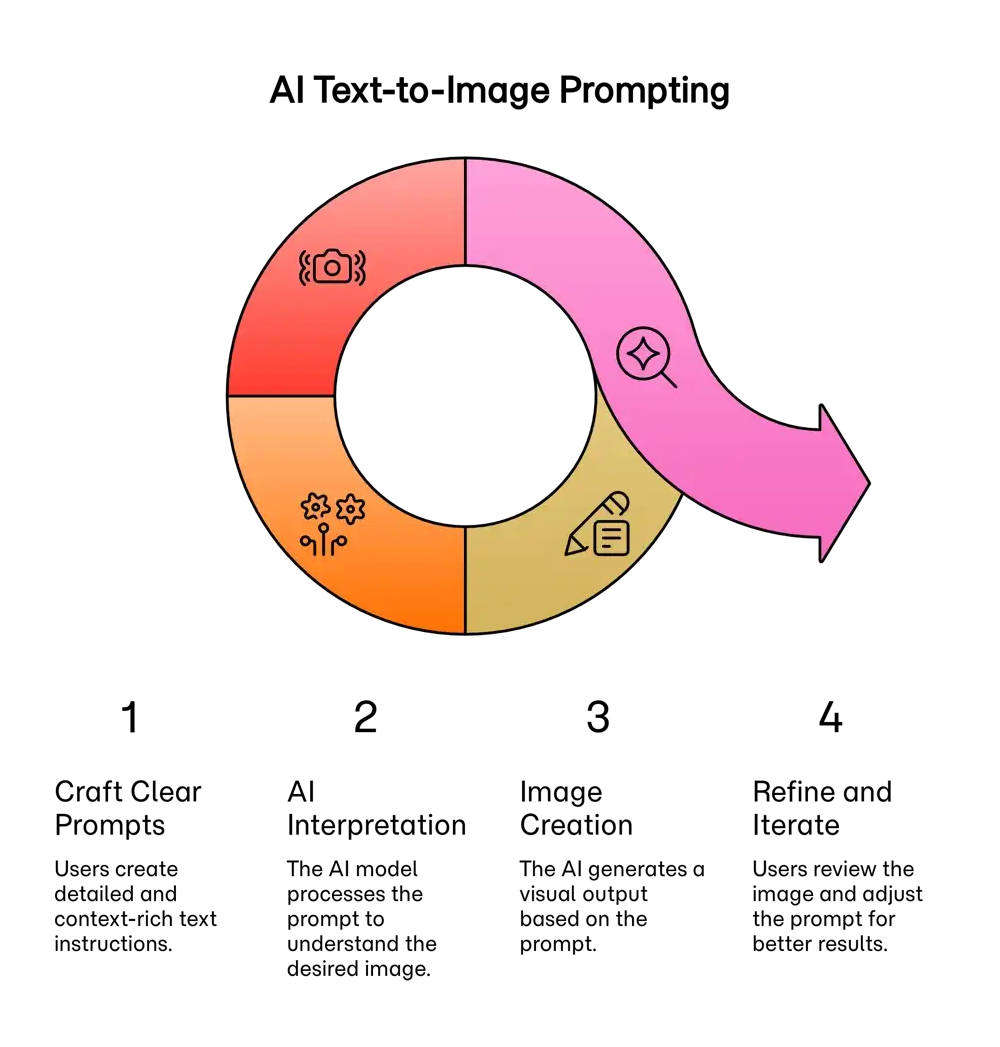
At its core, a text-to-image prompt is a set of instructions given to an AI model. A simple, vague prompt like "a car" will often result in a generic image, a principle known as garbage in, garbage out, as the AI makes numerous assumptions. An effective prompt provides a clear roadmap for the AI by being highly descriptive. A strong prompt structure should ideally contain a clear subject, define its context and environment, and specify the desired aesthetic, including details about lighting, color, mood, and composition. For instance, instead of "an armchair," a more effective prompt would be: "A modern armchair made of light oak and cream-colored fabric, in a bright, minimalist living room, with soft morning light coming from a large window on the left." This level of specificity provides a clear vision for the AI to interpret.
Advanced Prompting Techniques
To further refine outputs, creators can employ advanced techniques. These include using negative prompts to exclude unwanted elements like "blurry" or "distorted," ensuring a cleaner final image. Some platforms allow assigning weights to different words to emphasize their importance, giving you more control over the final composition. The process of iterative refinement, where you start with a simple idea and gradually add details over several generations, is a powerful workflow. Techniques like chain of thought prompting help in breaking down complex scenes into manageable parts for the AI. Combining text with reference images is another powerful, multimodal approach to guide the AI toward a specific style or composition.
Enhancing Creative and Commercial Endeavors
For artists and designers, mastering creative prompting opens up new avenues for expression and rapid prototyping. It allows for the quick exploration of unconventional styles and the generation of unique visuals for projects like concept art and storyboarding. In the commercial sector, businesses leverage AI image generation to create cost-effective and personalized materials for marketing and advertising. Companies can generate visuals tailored to specific audiences and campaigns, leading to increased engagement while significantly reducing the cost and time associated with traditional graphic design and photoshoots.
Transforming Academic Communication and Research
In academia, AI-generated images are becoming a powerful tool for research, teaching, and communication. They can be used to create high-quality conceptual illustrations and diagrams to help explain complex ideas, making learning more effective and engaging. This is especially useful for creating specific and customized stimuli for experiments, where stock images may be too generic. While many academic journals have strict policies against using AI-generated images as primary data, they are increasingly accepted for illustrative purposes, provided the methods and prompts are thoroughly documented. It's also important for the academic community to be aware of the potential for bias in AI-generated images and to establish best practices for their use to maintain research integrity.
Ready to transform your AI into a genius, all for Free?
Create your prompt. Writing it in your voice and style.
Click the Prompt Rocket button.
Receive your Better Prompt in seconds.
Choose your favorite AI model and click to share.
Summary of AI Text-to-Image Prompting
Understanding the nuances of prompt crafting for AI image generation is crucial for enhancing the quality and specificity of visual outputs across various fields. A prompt, which is essentially a text-based instruction, serves as the guiding force for the AI model, and its effectiveness directly shapes the final image. Providing clear, detailed, and context-rich prompts allows users to move beyond generic results and create visuals that precisely match their vision. In creative applications, artists and designers can accelerate their workflow by generating unique concepts, character designs, and detailed backgrounds, thereby augmenting their creative process. For academic purposes, complex topics can be made more accessible through custom diagrams, historical recreations, and scientific illustrations, enhancing visual learning and comprehension. In the commercial sector, businesses can rapidly produce high-quality, on-brand content for marketing campaigns, product mockups, and e-commerce platforms, significantly reducing costs and production time. Mastering the art of prompt crafting transforms AI image generators from a novelty into a powerful tool for targeted, high-quality visual creation in creative, academic, and commercial endeavors.
Foundations of Prompt Engineering
| Chapter | Title | Description |
|---|---|---|
| 1 | Fundamentals of AI Image Generation | Introduces the core concepts behind generative AI models like GANs and diffusion models. This chapter would explain how these technologies interpret text prompts to create novel images and establish the foundational role of prompt engineering. |
| 2 | The Anatomy of an Effective Prompt | Breaks down the essential components of a well-structured prompt, including subject, style, composition, lighting, color, and mood. It would provide a framework for layering details to achieve specific artistic and technical outcomes. |
| 3 | Core Techniques in Prompt Engineering | Explores foundational and advanced techniques for refining prompts. This chapter would cover iterative prompting, the use of negative prompts to exclude unwanted elements, and how to use specific keywords to influence the output. |
Applications of AI Image Generation
| Chapter | Title | Description |
|---|---|---|
| 4 | AI as a Creative Partner: Applications in Arts and Design | Showcases how AI can be integrated into the creative workflow for artists, illustrators, and graphic designers. It explores idea brainstorming, character concept art, style transfer, and the creation of unique digital artworks. |
| 5 | Enhancing Education and Research through Visualization | Focuses on the academic applications of AI image generation. This includes creating custom visual aids for teaching complex subjects, illustrating scientific concepts, generating historical scenes, and aiding in research visualization. |
| 6 | Revolutionizing Commercial and Marketing Content | Examines the impact of AI-generated images on business. This chapter details its use in creating compelling ad visuals, internal business content, website graphics, and establishing a consistent brand identity. |
| 7 | Prototyping and Visualization: Product, Fashion, and Architecture | Dives into the use of AI for generating realistic product mockups, prototyping fashion designs, and creating architectural renderings with interior design prompts. This aids in the design process and stakeholder communication. |
Advanced Topics and Responsibilities
| Chapter | Title | Description |
|---|---|---|
| 8 | Responsible Prompting and Ethical Considerations | Addresses the critical ethical dimensions of AI image generation. Topics include navigating model biases, understanding prompt rights and ownership, and the potential for creating misinformation or harmful content. |
| 9 | The Evolving Landscape of Generative AI | Discusses the rapid advancements and future trajectory of AI image synthesis. This would include emerging capabilities like multimodal prompts (text and image inputs), real-time generation, and greater integration into existing software. |
| 10 | Practical Workshop: Tools, Resources, and Case Studies | Offers a practical guide to popular AI image generation platforms. It would provide hands-on exercises, a curated list of resources like prompt libraries, and real-world case studies demonstrating successful prompt crafting across different industries. |