
By leveraging generative AI, companies can move beyond generic stock photos and produce a consistent stream of commercial imagery. This powerful technology offers a way to create bespoke visuals for marketing, product design, and internal communications. This isn't just about making pictures; it's a paradigm shift impacting how businesses engage audiences while navigating a new landscape of licensing, intellectual property, and creative workflows.
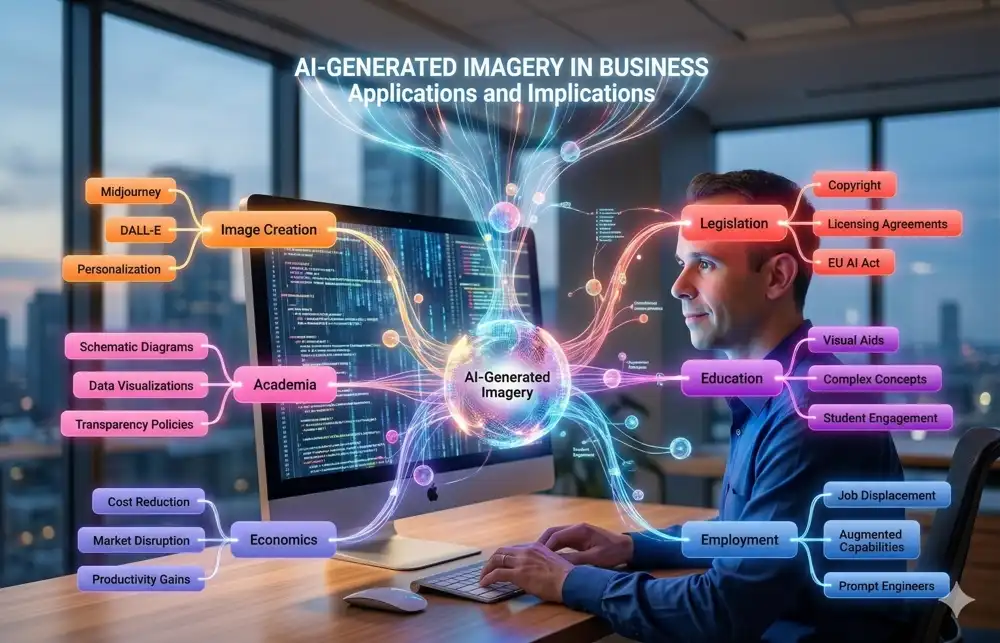
Image Creation Reimagined: Speed, Scale, and Consistency
The core advantage of AI image generation is its incredible efficiency. Tasks that traditionally required weeks of planning and costly photoshoots can now be accomplished in minutes from a simple text-to-image prompt. This agility enables businesses to rapidly create stunning visuals for social media campaigns, advertisements, and quick image-to-image prototyping. Enterprise AI platforms provide advanced tools for generating consistent, on-brand imagery. By training models on existing brand assets, companies can ensure every image adheres to specific visual styles, from choosing a style to color palettes. This deep customization is a game-changer for maintaining a cohesive brand identity and avoiding the uncanny valley.
Navigating the New Legal and Legislative Landscape
For any business, understanding the legal landscape of AI-generated content is critical. In the U.S., copyright law hinges on human authorship, which means that images created entirely by an AI may fall into the public domain. However, works that involve significant human creativity in editing or arranging AI elements can be copyrighted, though the courts are still defining what "sufficient" input entails. This ambiguity carries risk. To mitigate this, many AI platforms now train their diffusion models on licensed or public domain content and offer commercial licenses with legal indemnification to protect businesses. It is essential to understand the rights and ownership provided by your tool. Furthermore, the EU’s AI Act imposes transparency rules, requiring that AI-generated content be labeled to prevent consumer deception.
Academia and Education: Fostering Critical and Creative Engagement
The influence of AI imagery is rapidly growing in professional and educational fields. Researchers in academia are using AI to generate detailed visualizations of complex data, although publishers maintain strict policies requiring the disclosure of AI tool usage to ensure academic integrity. In the education sector, AI presents an opportunity to create highly engaging and customized learning materials. From illustrating scientific concepts with image abstraction to designing unique visual aids, AI helps create a more dynamic and accessible learning experience for all.
The Economic Impact: Market Growth and New Business Models
The economic advantages of adopting AI for image creation are enormous. The generative AI market is poised to add trillions of dollars in value to the global economy, fueled by the massive cost and time savings it provides. By lowering the reliance on traditional design and photography services, AI makes professional-quality visuals more attainable, particularly for small businesses. This shift is fueling new business models, including subscription-based AI platforms that offer scalable image generation. Across industries like e-commerce, media, and advertising, AI is not just a tool but a driver of business innovation.
Employment in the Age of AI: A Shifting Landscape
The emergence of AI is transforming the creative job market. While AI can automate routine design tasks, it is most powerful when used as an augmentation tool that boosts productivity. It frees designers and artists to concentrate on high-level strategy, concept development, and creative ideation. The ability to write effective text prompts, a skill known as prompt engineering, is becoming highly sought after. This demands both technical skill and specifically in language. New roles such as AI Art Director are appearing, highlighting a shift towards professionals who can collaborate with AI. The future belongs to those who blend artistic vision with technical proficiency in how to prompt better, using AI to expand their creative frontiers.
Generate On-Brand Visuals with BetterPrompt Text-to-Image for Business
Transform your creative workflow and produce consistent, high-quality images that align perfectly with your brand identity. It’s fast, simple, and free.
Write your prompt, describing the image in your own words.
Click the Prompt Rocket button to optimize it.
Receive an expertly crafted Better Prompt in seconds.
Take your new prompt to your favorite AI image generator.
| Application | How AI is Used for Business Imagery |
|---|---|
| Marketing & Advertising | Rapidly generate diverse ad creatives, social media posts, and campaign visuals. Enables large-scale A/B testing and personalization. |
| Product Design | Create realistic product mockups and conceptual designs before physical production. Visualize products in various settings and styles, including professional head shots. |
| Branding | Train AI models on brand guidelines to produce a consistent stream of on-brand imagery for internal business content and external campaigns, ensuring a cohesive visual identity. |
| Area | Impact of AI Image Generation |
|---|---|
| Cost & Efficiency | Dramatically reduces expenses and time associated with traditional photoshoots and graphic design services. See real cost and time savings. |
| Market Accessibility | Democratizes access to high-quality visuals, allowing small and medium-sized businesses to compete with larger enterprises. |
| Employment | Shifts creative roles towards strategy, prompt engineer skills, and AI collaboration. Automates repetitive tasks, creating demand for new hybrid creative/technical roles. |
| Consideration | Key Guidelines for Businesses |
|---|---|
| Copyright | Be aware that purely AI-generated images may lack copyright protection. Ensure your AI tool provider offers clear commercial rights and ownership. |
| Data & Training | Use platforms trained on ethically sourced, licensed, or public domain data to avoid infringement claims. Choose tools that use modern diffusion models built on safe datasets. |
| Transparency (EU) | Adhere to regulations like the EU AI Act, which may require labeling AI-generated content to ensure consumers are not misled. |