
To bridge the gap between raw human input and optimal machine execution, a new class of middleware has emerged: Prompt Optimiser Utilities. These utilities leverage algorithmic pre-processing modules to programmatically sanitize, restructure, and compress prompts before they ever reach the primary LLM. By treating prompts not as static text, but as dynamic code to be compiled and optimized, these systems are transforming how enterprises deploy AI at scale.
The Architecture of a Prompt Optimiser Utility
A Prompt Optimiser Utility acts as an intelligent gateway between the user (or application layer) and the target LLM. Rather than passing raw strings directly to an API, the utility routes the input through a multi-stage, algorithmic pipeline designed to maximize clarity and minimize computational waste.
This pipeline typically consists of several specialized modules:
- The Sanitization Engine: Strips out conversational fluff, corrects grammatical ambiguities, and neutralizes potential prompt injection vectors.
- The Structural Reformatter: Reorganizes the prompt into highly legible, machine-readable schemas (such as XML, JSON, or Markdown delimiters).
- The Token Compression Module: Eliminates semantic redundancy to minimize token consumption without losing critical context.
- The Dynamic Enrichment Module: Injects relevant context, few-shot examples, or system instructions tailored to the user's intent.
Algorithmic Pre-Processing: Sanitizing the Chaos
Raw user prompts are notoriously messy. They are often filled with polite filler ("Could you please kindly tell me..."), circular reasoning, typos, and structural disorganization. Algorithmic pre-processing modules use deterministic rules and lightweight, specialized language models to sanitize this input.
1. De-noising and Linguistic Normalization
The first step in sanitization is the removal of linguistic noise. Pre-processing modules run heuristic algorithms to strip out conversational pleasantries and redundant phrasing. For example, the phrase "I was wondering if you could help me write an email to my boss because I need to ask for a day off on Friday" is algorithmically reduced to its core intent and parameters: [Task: Write email] [Recipient: Boss] [Topic: Request time off] [Date: Friday].
2. Structural Delimitation
LLMs perform significantly better when instructions, context, and user data are clearly separated. Sanitization modules automatically wrap different components of a prompt in standardized tags. By converting a flat text prompt into a structured format using XML tags (<instruction>, <context>, <input_data>), the pre-processor prevents the model from confusing instructions with the data it is supposed to process.
Raw Input: "hey can u look at this text 'the product was okay but arrived late' and tell me if its positive or negative, also don't write a long essay just give me one word please thanks!!"
Sanitized Output:
<system>You are a sentiment analysis assistant. Respond with exactly one word: Positive, Negative, or Neutral.</system>

<input>the product was okay but arrived late</input>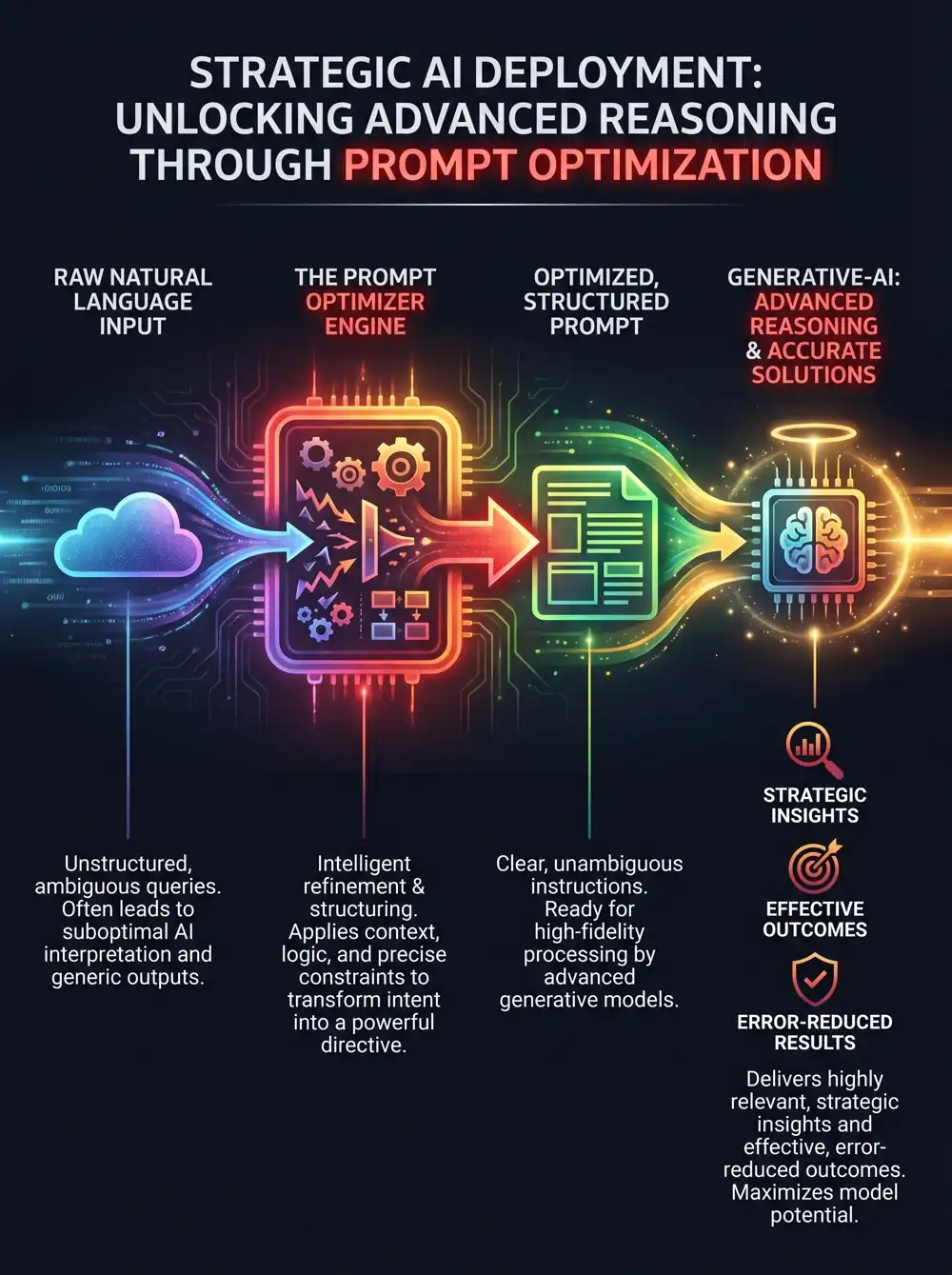
Prompt Enhancement and Algorithmic Rewriting
Sanitization cleans the prompt, but prompt enhancement actively improves it. Prompt rewriting modules use algorithmic techniques to translate vague user queries into highly explicit instructions that align with the target LLM's latent cognitive pathways.
Meta-Prompting and Chain-of-Thought Injection
If a user asks a complex logical question, a simple sanitization module isn't enough. The rewriting module will detect the complexity of the query and programmatically inject reasoning frameworks. It might append instructions like "Let's think step-by-step" or structure the prompt to force the model to generate its reasoning in a hidden scratchpad before delivering the final answer. This algorithmic rewriting ensures that the model's reasoning capabilities are fully leveraged without requiring the user to know how to write a Chain-of-Thought prompt.
Few-Shot In-Context Learning (ICL) Selection
One of the most powerful enhancement techniques is the dynamic injection of few-shot examples. An advanced pre-processing utility does not use static examples. Instead, it uses a vector database to perform a semantic search on the user's sanitized input, retrieves the three most relevant historical query-response pairs, and injects them into the prompt as <example> blocks. This dynamic few-shot enhancement dramatically increases the accuracy and stylistic consistency of the LLM's output.
Ready to transform your AI into a genius, all for Free?
Create your prompt. Write it in your own voice and style.
Click the Prompt Rocket button.
Receive your Better Prompt in seconds.
Choose your favorite AI model and click to share.
Token Efficiency and Cost Mitigation
In enterprise AI deployments, tokens are currency. Every redundant word, repetitive instruction, or bloated system prompt directly translates to increased latency and higher API costs. Furthermore, excessively long prompts can trigger the "lost in the middle" phenomenon, where LLMs overlook crucial information placed in the middle of a massive context window.
To combat this, Prompt Optimiser Utilities employ sophisticated token efficiency algorithms. These modules analyze the semantic density of a prompt and compress it using several techniques:
- Semantic Compression: Utilizing specialized, highly efficient models (such as LLMLingua) to identify and remove non-essential tokens. These algorithms calculate the information entropy of each word in a prompt and discard tokens that contribute little to the overall meaning, often reducing prompt size by 20% to 50% while preserving the original intent and output quality.
- Stop-Word and Redundancy Filtering: Programmatically stripping out grammatical articles, repetitive adjectives, and redundant system instructions that do not alter the model's behavioral constraints.
- Context Pruning: When dealing with Retrieval-Augmented Generation (RAG), pre-processors analyze retrieved document chunks, rank them by semantic relevance, and discard low-scoring paragraphs to prevent prompt bloat.
// Conceptual representation of Token Compression
Raw Prompt: "In order to successfully complete this task, it is highly recommended that you carefully analyze the following financial document and extract all of the key metrics." (28 tokens)

Compressed Prompt: "Analyze financial document. Extract key metrics." (7 tokens)
Token Savings: 75% | Semantic Loss: 0%
AI Tools and the Modern Optimization Stack
The ecosystem of prompt optimization has evolved from basic Python regex scripts into a sophisticated stack of specialized AI tools and frameworks. Developers looking to implement algorithmic pre-processing can leverage several powerful open-source and commercial solutions:
- DSPy (Declarative Self-improving Language Programs): Developed by Stanford, DSPy represents a paradigm shift away from manual prompt engineering. It treats prompts as code rather than strings. DSPy allows developers to define a pipeline's signature and uses algorithmic optimizers (like BootstrapFewShot or MIPRO) to automatically compile, rewrite, and tune prompts based on a small set of training examples.
- LLMLingua: An open-source project from Microsoft that uses a compact, active-learning-based language model to compress long prompts and contexts. It achieves up to 20x compression with minimal loss of accuracy, making it a cornerstone tool for token efficiency.
- LangChain and LlamaIndex Middleware: These popular orchestration frameworks offer built-in prompt templates, output parsers, and custom serialization layers that standardize and sanitize inputs before they are dispatched to model endpoints.
- Custom Gateway Proxies: Many enterprises deploy custom API gateways (built on top of tools like Kong or custom FastAPI microservices) that intercept incoming user queries, run regex-based sanitization, check for prompt injection using specialized classifiers, and format the payload into optimized JSON structures.
| Role | Position | Unique Selling Point | Flexibility | Problem Solving | Saves Money | Solutions | Summary | Use Case |
|---|---|---|---|---|---|---|---|---|
| Coders | Developers | Unleash your 10x | No more hopping between agents | Reduce tech debt & hallucinations | Get it right 1st time, reduce token usage | Minimizes scope creep and code bloat | Generate clear project requirements | Merge multiple ideas and prompts |
| Leaders | Professionals | Be good, Be better prompt | No vendor lock-in or tenancy, works with any AI | Reduces excessive complementary language | Prompt more assertively and instructively | Improved data privacy, trust and safety | Summarize outline requirements | Prompt refinement and productivity boost |
| Higher Education | Students | Give your studies the edge | Use your favourite, or try a new AI chat | Improved accuracy and professionalism | Saves tokens, extends context, it’s FREE | Articulate maths & coding tasks easily | Simplify complex questions and ideas | Prompt smarter and retain your identity |
Performance Tuning and Benchmarking
Implementing a prompt optimizer introduces an architectural trade-off: you are adding a pre-processing step (which incurs its own computational overhead and latency) to optimize a downstream LLM call. Therefore, rigorous performance tuning is essential to ensure the utility provides a net benefit.
The Latency vs. Quality Trade-off
When tuning a prompt optimization pipeline, developers must balance the time spent optimizing the prompt against the time saved during generation. If a token compression module takes 150 milliseconds to run but reduces the downstream LLM's generation time by 500 milliseconds (due to a shorter prompt and faster time-to-first-token), the system achieves a net latency reduction of 350 milliseconds, alongside a direct cost saving.
Automated Evaluation and A/B Testing
To tune these utilities, developers use automated evaluation frameworks (such as Ragas, TruLens, or promptfoo) to benchmark prompt variations. The performance tuning workflow typically follows these steps:
- Dataset Curation: Assemble a golden dataset of representative user queries and desired outputs.
- Algorithmic Variation: Use a prompt optimizer to generate multiple candidate prompt structures (varying the level of token compression or changing the XML schema).
- Execution and Scoring: Run the candidate prompts against the target LLM and score the outputs based on metrics such as semantic similarity, factual accuracy, instruction adherence, and token cost.
- Hyperparameter Optimization: Adjust the pre-processing parameters (such as compression thresholds or few-shot selection algorithms) to find the mathematical sweet spot that yields the highest quality at the lowest cost.