
A subtle smile, a curious glance, a gentle nod these small movements can transform a still, century-old photograph into a vibrant, living moment. This is the power of nostalgic AI historical animation, a technology that is fundamentally changing how we connect with history. By applying generative AI to static images, we can create deeply emotional animations that offer a dynamic new way to experience the past, with profound implications for everything from personal remembrance to academic research.
The technology, which gained widespread popularity through online genealogy platforms like MyHeritage with its "Deep Nostalgia" feature, breathes a semblance of life into the stoic faces of our ancestors and historical figures. For many, seeing a long-deceased relative's eyes blink or their lips curve into a smile is a powerful experience, bridging the gap between generations in a way that was previously unimaginable and making history feel more immediate and personal.
How AI Brings Cherished Memories to Life
At its core, nostalgic photo animation utilizes machine learning and generative adversarial networks (GANs). These complex algorithms are trained on vast datasets of human facial movements to predict how a person in a two-dimensional photograph might have moved. The AI identifies key facial landmarks like eyes, mouth, and nose and then applies realistic motion patterns from pre-recorded "driver videos" to these features, generating a short video that simulates natural expressions. The result is not an authentic video but a "technological simulation" of what the person might have looked like in motion, designed to evoke a powerful sense of nostalgia.
Applications in Personal Remembrance and Genealogy
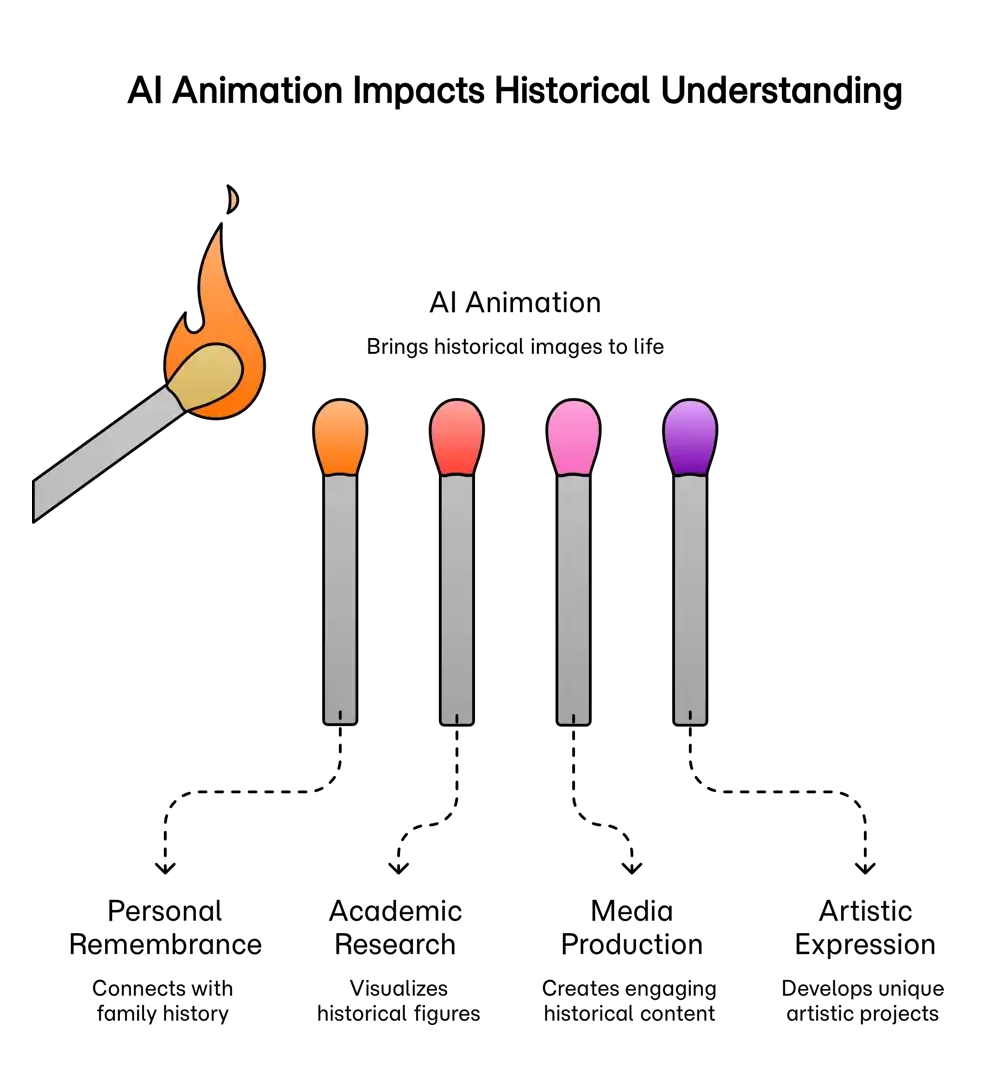
The most widespread use of this technology has been for personal remembrance and genealogy. It allows individuals to connect with their family history on a more emotional level, viewing ancestors not just as figures in a sepia-toned past, but as real people. For those who have no video recordings of their loved ones, these animations can be a powerful way to feel a renewed connection, turning static family archives into engaging keepsakes for a new generation.
| Genealogy and Personal Use Examples |
|---|
| Animating old family portraits for genealogy projects. |
| Sharing animated images on social media for anniversaries or tributes. |
| Creating moving keepsakes for family reunions. |
Applications in Education and Museums
Beyond the family album, AI animation is making its mark in historical and educational contexts. Museums and cultural institutions are exploring its potential to create more immersive exhibits. A notable example is the "Moving Archives" project, a collaboration between Google Arts & Culture and the Harley-Davidson Museum, which uses AI to animate archival photographs, allowing visitors to see a 1920s factory floor hum with activity. This approach offers a new form of storytelling that can captivate a global audience and make history more relatable.
| Education and Museum Examples |
|---|
| Creating interactive and engaging museum exhibits. |
| Illustrating historical narratives for students in the classroom. |
| Helping researchers visualize historical figures for presentations. |
Applications in Documentaries and Media
In media, the technology has applications in documentary filmmaking, where it can be used to add a dynamic element to stories that rely heavily on still photographs. Instead of a static image, filmmakers can show a historical figure who appears momentarily alive, adding a dramatic and emotional effect to the narrative. This technique provides a visually engaging way to use archival materials and bring historical periods to life for viewers.
| Media and Documentary Examples |
|---|
| History documentaries using animated portraits of key figures. |
| Online content creators making videos that bring historical periods to life. |
| Adding visual flair to media productions that use archival photos. |
The Ethical Tightrope: Authenticity, Grief, and Misinformation
Despite its compelling power, the rise of nostalgic AI animation is accompanied by significant ethical considerations. A primary concern is the blurring of lines between authenticity and simulation. Critics argue that these animations can create a "digital facelift," subtly altering historical portraits to conform to modern standards, which can reinforce a whitewashed or normative view of the past. The AI can smooth features, change hairlines, and even add makeup, creating an idealized rather than an accurate representation.
Furthermore, the psychological impact on the living is a complex issue. For some, seeing a departed loved one move again is comforting, but for others, it can be deeply unsettling, creating a confusing blend of memory and digital reality that sometimes touches the uncanny valley. The potential for misuse also looms large. The same technology can be used to create deepfakes of historical figures, raising serious concerns about the spread of misinformation and the erosion of trust in historical sources. This necessitates a critical approach from both creators and consumers, with an emphasiz on AI-safety and responsible use.
A New Chapter in Our Relationship with the Past
AI-powered nostalgic historical animation offers a powerful new way to engage with history, making it feel more immediate and personal than ever before. It allows us to look into the eyes of those who came before us and imagine them not as distant figures, but as living, breathing individuals. From the emotional reunion with a lost family member to the dynamic reimagining of a historical event, the applications are as diverse as they are compelling.
However, as we embrace this technology, we must proceed with caution. Balancing the desire for a more intimate connection with the past against the need for historical accuracy and ethical responsibility is crucial. By acknowledging that these animations are simulations (not reality) and by engaging in a thoughtful conversation about their use, we can harness their power to enrich our understanding of history without sacrificing the integrity of the very past we seek to bring to life.
Ready to transform your AI into a genius, all for Free?
Create your prompt. Writing it in your voice and style.
Click the Prompt Rocket button.
Receive your Better Prompt in seconds.
Choose your favorite AI model and click to share.
Summary of Breathing New Life into History with AI Animation
AI-powered historical animation breathes life into static images of the past by transforming them into short, moving videos. Using deep learning technologies, often called "deep nostalgia," these tools analyze a photograph, identify facial features, and then apply a pre-recorded driver video of subtle human movements like blinks, head turns, and smiles to the still face. This process creates a lifelike simulation, making it seem as though the person in the photograph was captured on video. The effect can be profoundly emotional, fostering a powerful and nostalgic connection by allowing viewers to see ancestors and historical figures not as static artifacts, but as relatable individuals. This technology makes history feel more immediate and personal, turning a distant memory into a living moment. For many, seeing a long-lost relative seemingly move and smile offers a deeply moving way to connect with their family history.