
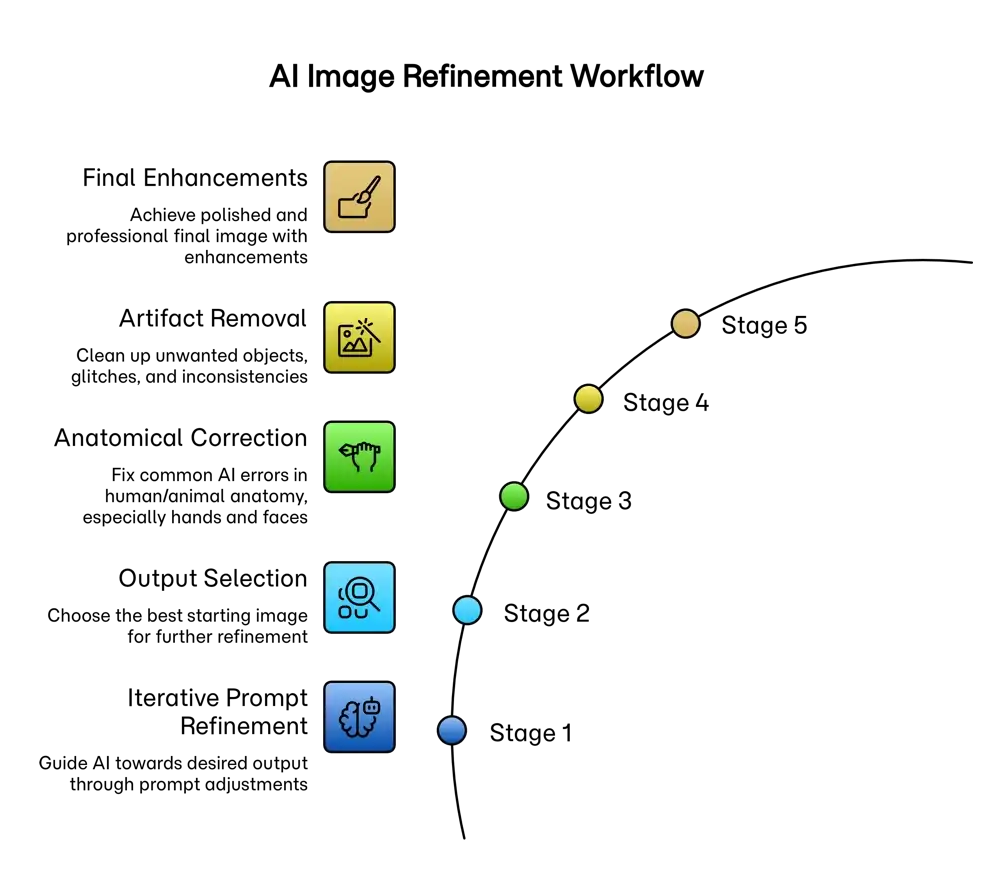
The rise of generative AI has revolutionized digital art, enabling the creation of complex visuals from simple text. However, achieving a flawless image is not a one-shot process. It requires a partnership between the user and the AI, a practice defined by robust AI oversight. This involves a continuous cycle of prompt refinement, output selection, and manual correction of AI-generated flaws, ensuring the final image aligns with the creator's vision and quality standards. This human in the loop (HITL) approach is critical for bridging the gap between automated generation and human creativity.
The Iterative Oversight Loop: Prompting and Selection
Effective human oversight begins with an iterative dialogue with the AI. The creative process is not about crafting a single perfect command but engaging in a feedback loop. It starts with a base prompt, and the AI returns a set of initial images. Here, the user acts as a curator, selecting the output that best captures the intended concept, composition, and mood.
This selection initiates the prompt iterative refinement phase. Instead of starting over, the user modifies the prompt to guide the AI more precisely. This involves adding stylistic descriptors ("in the style of Ansel Adams"), defining lighting ("golden hour lighting"), or specifying composition ("wide-angle shot"). A key technique in prompt engineering is the use of negative prompting, which instructs the AI on what to exclude, helping to prevent common errors. This cycle of generating, selecting, and refining is repeated until the AI's output is as close as possible to the user's vision.
Post-Generation Oversight: The Human Touch in Editing
Even sophisticated AI models produce images with imperfections. Common issues include visual artifacts, illogical textures, and notorious anatomical distortions, especially in complex features like hands, which may have the wrong number of fingers.
This is where traditional photo editing prompt tools like Adobe Photoshop, GIMP, or Affinity Photo are indispensable. These tools provide the precision needed to correct AI shortcomings. For example, an artist can fix a misshapen hand using clone stamps, healing brushes, or generative fill features to reconstruct parts of the image. In some cases, elements from other AI-generated images or stock photos are composited to achieve a natural look. Visual artifacts can be painted over, blended, or removed entirely. This post-production phase, a crucial part of oversight, allows the creator to refine the AI's raw output to a professional standard, merging rapid ideation with skilled human artistry.
Ready to transform your AI into a genius, all for Free?
Create your prompt. Writing it in your voice and style.
Click the Prompt Rocket button.
Receive your Better Prompt in seconds.
Choose your favorite AI model and click to share.
Summary of AI Image Oversight
Integrating human oversight into AI image generation is a multi-layered process that refines a text prompt into a high-quality visual. The process starts with the iterative refinement of prompts, where a user guides the AI through successive versions to realize a creative vision. This involves a conversational loop: generating an image, evaluating it, and modifying the prompt with more specific details or negative constraints. Once a suitable image is generated, the user selects the best option. Following this, traditional photo editing software becomes essential for post-production. A human editor can address common AI flaws like anatomical inaccuracies or visual artifacts. By using a range of digital tools for retouching prompt, the editor manually corrects and refines image elements, ensuring the final product aligns with the initial concept and meets professional quality standards, free from the tell-tale imperfections of automation.
Prompt-Based Oversight Techniques
| Stage | Objective | Human Actions & Techniques | Tools |
|---|---|---|---|
| 1. Iterative Prompt Refinement | To guide the AI towards the desired conceptual and stylistic output. |
|
AI Image Generation Platforms (Midjourney, DALL-E, Stable Diffusion) |
| 2. Output Selection | To choose the best possible starting point for further refinement. |
|
AI Image Generation Platforms |
Post-Production Oversight Techniques
| Stage | Objective | Human Actions & Techniques | Tools |
|---|---|---|---|
| 3. Correction of Inaccuracies | To fix common AI errors in figures, especially rendering hands and faces. |
|
Adobe Photoshop, GIMP, Affinity Photo |
| 4. Removal of Artifacts & Flaws | To clean up unwanted objects, glitches, or inconsistencies. |
|
Adobe Photoshop, AI-powered cleanup tools |
| 5. Final Enhancements | To achieve a polished and professional final image. |
|
Adobe Photoshop, Lightroom, Capture One |