
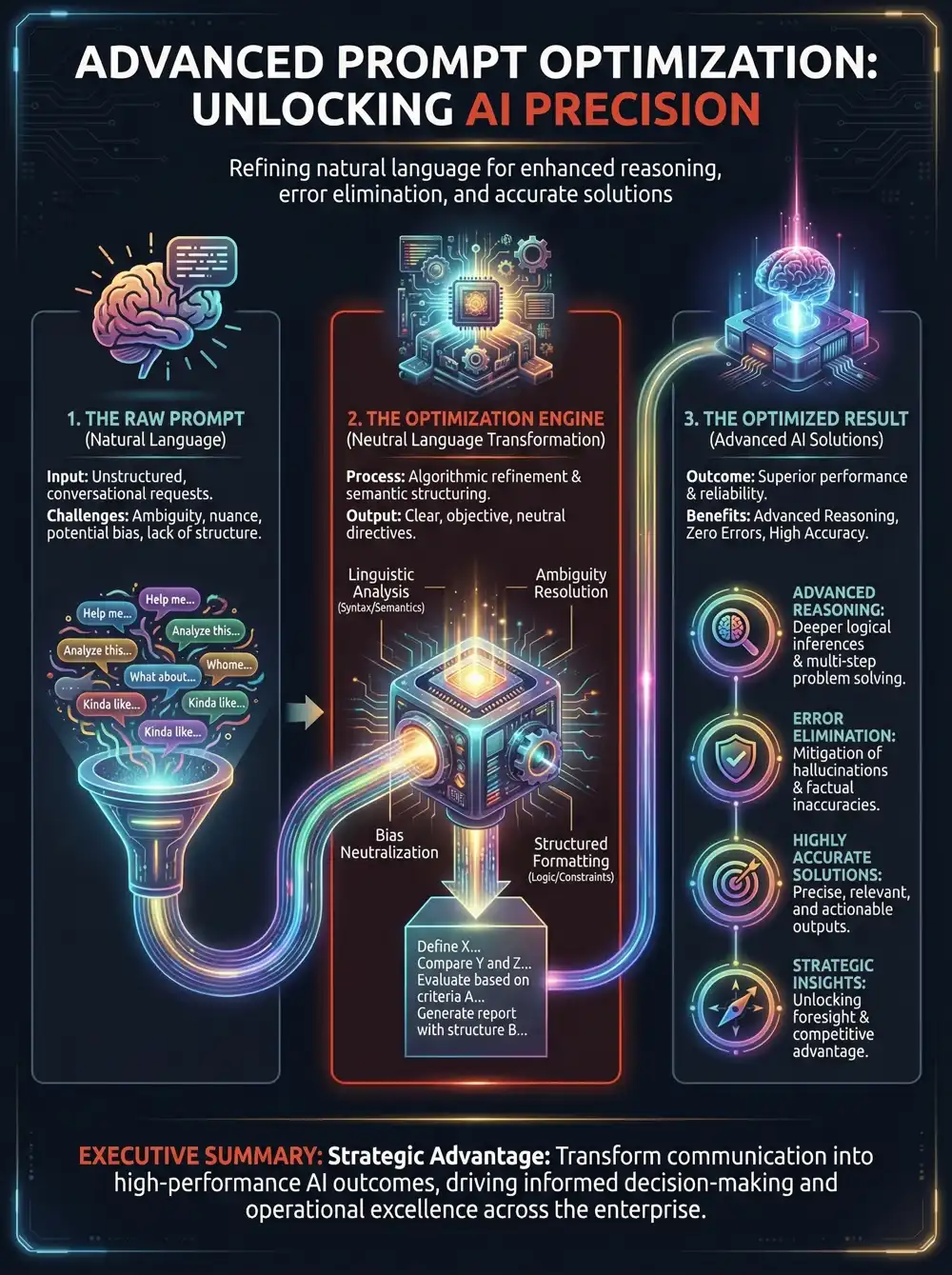
A prompt optimizer is an essential tool that acts as an intelligent translation layer between human intent and large language models. It automatically converts your spoken language into the precise, structured instructions that AI models require to function at their peak. This automated refinement process is crucial for eliminating common human errors, such as vagueness or cognitive bias, which frequently lead to irrelevant answers or AI hallucinations. By standardizing the input, a prompt optimizer ensures the AI receives a technically superior prompt every time, enhancing output reliability regardless of your expertise in prompt engineering.
The Power of Neutral Language for English-trained reasoning
A key function of a superior prompt optimizer is its ability to rephrase your queries using neutral language. Neutral language is objective, factual, and free from emotional or leading words that can inadvertently bias an AI's response. This neutrality is vital because it helps avoid the classic garbage in, garbage out dilemma, promoting English-trained reasoning and effective problem solving. Instead of guiding the AI toward a preconceived conclusion, a neutral prompt encourages the model to analyze a problem on its merits. This shift from subjective questioning to objective analysis allows the AI to engage in a more logical deductive process, resulting in more accurate solutions.
How a Prompt Optimizer Mitigates Common Errors
By systematically refining user inputs, a prompt optimizer addresses predictable types of human error that degrade AI performance. To better understand this impact, we can categorize these improvements into structural, contextual, and logical optimizations. This structured approach ensures that prompts are crafted to deliver the most consistent and high-quality results.
1. Structural & Formatting Optimizations
Proper prompt structure and prompt format are foundational for machine-readable outputs.
| Type of Human Error | Description of Error | Optimizer Solution |
|---|---|---|
| Ambiguity & Vagueness | The user provides a generic request without defining its scope, length, or audience, reducing prompt clarity. | Context Injection: The optimizer automatically expands the prompt to include critical parameters for length, tone, and target audience, ensuring a comprehensive response. |
| Incorrect Syntax | The user needs data for a script or database but forgets to specify the required structure. | Schema Enforcement: The tool wraps the prompt in strict instructions to output valid JSON, XML, or another machine-readable format. |
2. Contextual & Cognitive Optimizations
Providing the right prompt context background prevents the AI from making biased or uninformed assumptions.
| Type of Human Error | Description of Error | Optimizer Solution |
|---|---|---|
| Cognitive Bias | The user inadvertently uses leading language that biases the AI toward a specific, potentially incorrect, answer. | Neutral Language Reframing: The optimizer rephrases the query to be objective and factual, encouraging data-driven answers rather than user-suggested ones. |
| Context Amnesia | The user forgets to include necessary background information or constraints from earlier in a workflow. | Dynamic Retrieval: The system automatically retrieves and appends relevant documentation, providing the LLM with the full context it needs. |
3. Logic & Reasoning Optimizations
Complex tasks require the AI to show its work to avoid calculation errors or logical fallacies.
| Type of Human Error | Description of Error | Optimizer Solution |
|---|---|---|
| Lack of Step-by-Step Reasoning | The user asks for a complex conclusion without instructing the AI to break down the problem. | Chain-of-Thought (CoT) Injection: The optimizer inserts instructions for the AI to "think step-by-step," forcing the model to validate its logical progression before generating a final answer. |
Ready to transform your AI into a genius, all for Free?
Create your prompt. Write it in your own voice and style.
Click the Prompt Rocket button.
Receive your Better Prompt in seconds.
Choose your favorite AI model and click to share.
| Role | Position | Unique Selling Point | Flexibility | Problem Solving | Saves Money | Solutions | Summary | Use Case |
|---|---|---|---|---|---|---|---|---|
| Coders | Developers | Unleash your 10x | No more hopping between agents | Reduce tech debt & hallucinations | Get it right 1st time, reduce token usage | Minimizes scope creep and code bloat | Generate clear project requirements | Merge multiple ideas and prompts |
| Leaders | Professionals | Be good, Be better prompt | No vendor lock-in or tenancy, works with any AI | Reduces excessive complementary language | Prompt more assertively and instructively | Improved data privacy, trust and safety | Summarize outline requirements | Prompt refinement and productivity boost |
| Higher Education | Students | Give your studies the edge | Use your favourite, or try a new AI chat | Improved accuracy and professionalism | Saves tokens, extends context, it’s FREE | Articulate maths & coding tasks easily | Simplify complex questions and ideas | Prompt smarter and retain your identity |